

Local
Asian countries evacuate close to 100 citizens from Maldives


Countries in East Asia and Southeast Asia have evacuated 94 of their citizens stranded in the Maldives due to travel restrictions stemming from the coronavirus outbreak.
A chartered AirAsia flight carried 52 Malaysians, as well as 36 Taiwanese and six Japanese nationals from Male to Kuala Lumpur in Malaysia Friday evening.

The Taiwanese and Japanese nationals continued on to their respective home countries Saturday.
The latest repatriation operation follows similar exercises by India, Sri Lanka, Indonesia, Philippines, Thailand, Russia, Turkey and Italy in recent weeks.
The EU and UK have also evacuated their nationals from the Indian Ocean tourist paradise.
The Maldives has enforced a blanket suspension of on-arrival visa in a bid to combat the spread of the novel coronavirus.
Even before the visa suspension, the Maldives had closed its borders to arrivals from some of the worst-hit countries, including mainland China, Italy, Bangladesh, Iran, Spain, the United Kingdom, Malaysia and Sri Lanka. Visitors from three regions of Germany (Bavaria, North Rhine-Westphalia and Baden-Württemberg), two regions of France (Île-de-France and Grand Est) and two regions of South Korea were also banned from entering the country.
All direct flights to and from China, Italy, South Korea and Iran were also cancelled.
Cruise ships and foreign yachts were also banned from docking at any of the country’s ports.
The coronavirus outbreak has hit the Maldivian economy hard, as travel restrictions and other preventive measures affect the country’s lucrative tourism industry, which contributes the bulk of the island nation’s state revenue and foreign reserves.
Before the pandemic, the government had been bullish about tourism prospects, targeting two million, high-spending holidaymakers this year after last year’s record 1.7 million.
However, tourist arrivals saw a year-over-year decline of 22.8 per cent in the first 10 days of March. Officials say the number of tourist arrivals to the Maldives could drop by half in 2020.
With the visa suspension in effect and no international airlines flying into the country, several resorts across the Maldives had been closed.
Tourism has been the bedrock of the Maldives’ economic success. The $5 billion-dollar economy grew by 6.7 per cent in 2018 with tourism generating 60 per cent of foreign income.
However, the government is at present projecting a possible 13 per cent economic contraction this year — an estimated $778 million hit.
On March 8, Maldives reported its first cases of the novel coronavirus, as two hotel employees tested positive for Covid-19 at a luxury resort in the archipelago.
Eighteen more cases — all foreigners working or staying resorts and liveaboard vessels except five Maldivians who had returned from abroad — were later identified.
A six-case cluster of locals, detected in capital Male on April 15, confirmed community transmission of the coronavirus. Several more clusters have since been identified, bringing the total number of confirmed case in the Maldives to 1,031.
Four deaths have been reported and 49 have made full recoveries.
The Maldives announced a state of public health emergency on March 12, the first such declaration under a recent public health protection law.
The public health emergency declaration has allowed the government to introduce a series of unprecedented restrictive and social distancing measures, including stay-at-home orders in capital Male and its suburbs, a ban on inter-island transport and public gatherings across the country, and a nationwide closing of government offices, schools, colleges and universities.
Non-essential services and public places in the capital such as gyms, cinemas and parks have also been shut.
Restaurants and cafes in the capital have been asked to stop dine-in service and switch to takeaway and delivery.
A nationwide shutdown of all guesthouses, city hotels and spa facilities located on inhabited islands is also in effect.



The Atmosphere Foundation has published its inaugural annual report, bringing together the stories and results of its work across the Maldives during 2025. The report documents a year shaped by close collaboration with island councils, schools, universities, community organisations and individuals working to create lasting opportunities within their communities.
Established as the community and sustainability arm of Atmosphere Core, Atmosphere Foundation works by listening to communities and supporting ideas grounded in local priorities. The Annual Report 2025 offers a detailed account of this approach in action, covering initiatives in education, livelihoods, health, community wellbeing and environmental protection.
During the year, the Foundation worked alongside 47 implementing partners and engaged 37 experts across its programmes. Its initiatives supported more than 1,440 households and 3,599 students across 38 schools and two universities. The Foundation also conducted 91 training sessions, engaged 913 parents through awareness programmes and provided skills development opportunities for 463 teachers.
Environmental action remained a major focus. Through the Foundation’s flagship Bamboo for Climate Mitigation project, 3,722 bamboo plants were planted across 48 islands in every atoll of the Maldives. The programme has involved more than 23 community groups and 18 island councils. At the Vaikaradhoo Bamboo Park, the local council extended the initiative by replanting 200 bamboo cuttings across the island, demonstrating how a supported project can grow under community ownership.
The Foundation also partnered with the Maldives National University on a scientific study examining how different bamboo species grow in island environments. The research will help establish a stronger body of local knowledge to guide future cultivation and understand bamboo’s potential ecological role in the Maldives.
Alongside its environmental programmes, the Foundation supported practical routes towards income generation. In HDh. Vaikaradhoo, a soft toy initiative involving 14 households began producing fabric turtles and crabs for young guests visiting Atmosphere Core resorts.

Education initiatives ranged from improving preschool learning environments to placing locally relevant books in schools and libraries. The Foundation supported the printing of 1,000 copies of the Dhivehi children’s book Ainee aai Velaa, created with the Olive Ridley Project Maldives, and contributed towards 1,000 copies of Atoll and Island Formation in the Maldives. The latter was distributed free of charge as an educational resource for students across the country.
Health and community care programmes included 779 vision screenings and screenings for 112 people through community-based hearing camps. Other initiatives addressed healthy ageing, nutrition, non-communicable diseases and domestic violence awareness, reflecting the range of needs identified through the Foundation’s community partnerships.
Commenting on the report, Ismail Faseeh, Senior Vice President of Atmosphere Foundation, said: “Real change does not happen alone. It grows when communities, councils, educators and partners come together, each bringing their own knowledge and strengths. This report is a reflection of the trust communities have placed in us and of what becomes possible when people work towards a shared purpose.”
Rather than presenting support as a one-way contribution, the report recognises the communities and partners who shaped each initiative. Eighteen focus groups were conducted during the year to better understand community needs and help ensure that programmes remained locally relevant.
Through the publication of its first annual report, Atmosphere Foundation aims to provide a transparent record of its progress while recognising the many people and organisations behind it. Together, the projects illustrate how practical support, shared knowledge and local ownership can help good ideas take root and grow.
Action
From zero experience to professional careers: Atmosphere Foundation celebrates Divemaster graduates
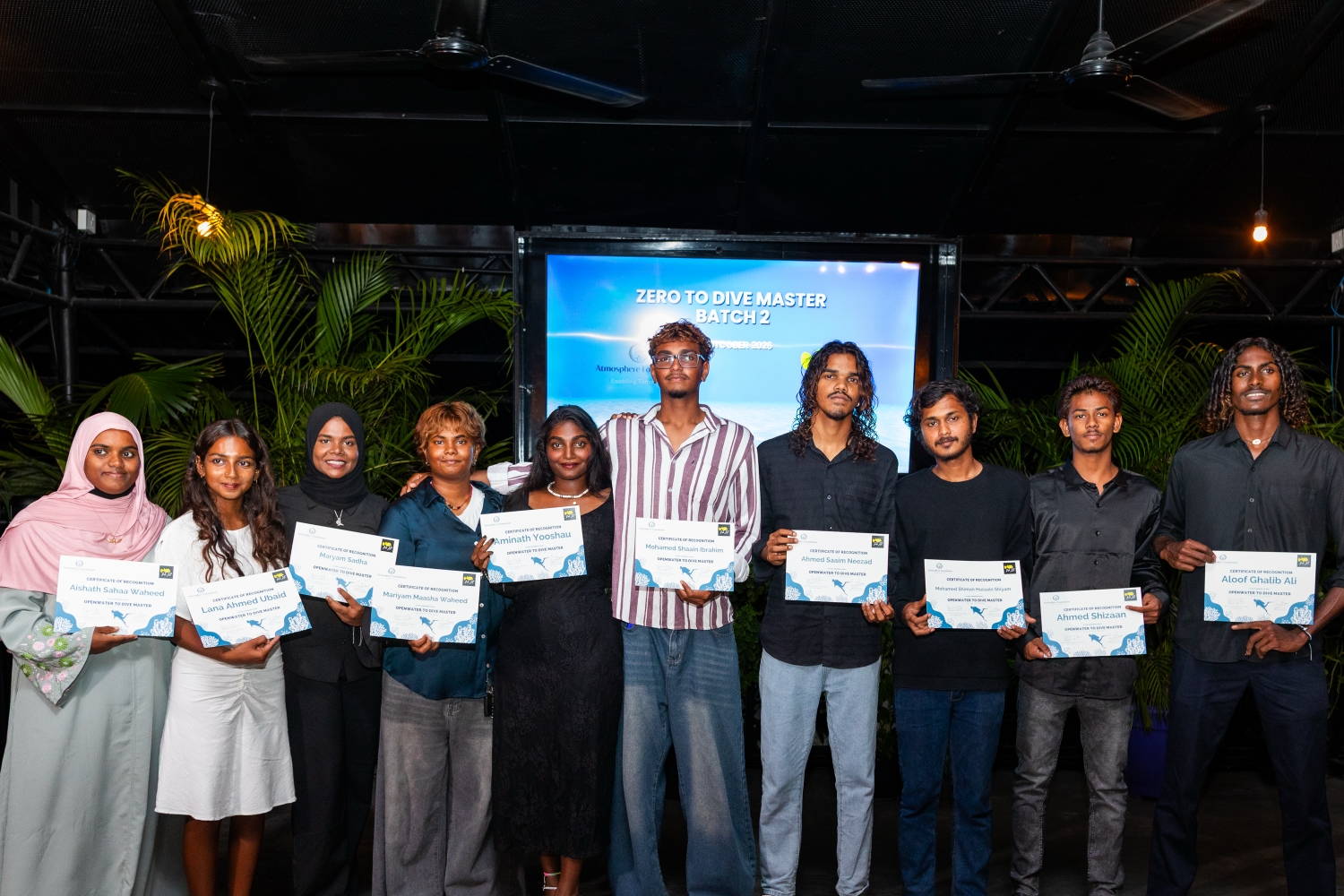
Atmosphere Foundation has celebrated the graduation of the second batch of its ‘Zero to Divemaster’ Scholarship Programme, bringing the total number of young Maldivians trained through the initiative to 20 as the Foundation continues to build pathways into professional careers in the country’s diving industry.
Ten participants completed the second batch of the three-month programme, which takes students through a structured training pathway from PADI Open Water Diver to Advanced Open Water Diver, Emergency First Response, Rescue Diver and, ultimately, professional Divemaster certification.

Delivered in partnership with Moodhu Bulhaa Dive Centre in Vilimalé, the programme is designed to enable Maldivians to enter the professional diving industry even without previous diving experience. The second batch, comprising five women and five men, began training in July following the completion of the inaugural cohort.
The latest graduation builds on strong outcomes from the first batch, which began in April 2026 with 10 participants. All 10 successfully obtained their professional Divemaster certifications, while nine have since secured employment across safari vessels, resorts and island-based dive centres.

The 90 per cent employment rate among the first batch highlights the programme’s success in translating professional training into direct employment opportunities within the Maldives’ tourism and marine sectors.
Beyond technical diving skills, the programme provides participants with training in safety, emergency response and the responsibilities associated with working as a professional Divemaster. The progressive training structure is intended to equip graduates with both the qualifications and practical competencies required to work in professional diving environments.
A key component of the initiative is the level of financial support provided to scholarship recipients. Atmosphere Foundation covers tuition, required certification and registration fees, while also providing accommodation and meals during the programme. The scholarship for the second batch additionally covered training materials and dive insurance, helping remove financial barriers that could otherwise prevent participants from pursuing professional diving qualifications.

By covering both the cost of training and participants’ day-to-day living requirements during the course, the programme allows scholarship recipients to focus on developing their diving skills and completing the demanding progression towards Divemaster certification.
The programme also links scholarship support with a longer-term commitment to the Maldives. Participants agree to work within the country’s diving and marine industry for at least two years after successfully completing their certification, helping ensure that the skills developed through the initiative contribute directly to the local workforce.
With diving forming an important part of the Maldives’ tourism industry, the initiative seeks to expand opportunities for Maldivians to develop specialised skills and pursue careers in an area where trained professionals are required across resorts, liveaboards and local dive centres.

The results of the first cohort provide an early indication of the programme’s potential. While only three graduates had secured jobs when the second batch was launched in July, that figure has since increased to nine, reflecting continued progression into employment following certification.
Following the completion of two batches, Atmosphere Foundation has confirmed that the Zero to Divemaster Scholarship Programme will continue, providing further opportunities for Maldivians seeking to enter the professional diving industry.

With 20 participants now having completed the programme across its first two cohorts, Zero to Divemaster is developing from a training initiative into an employment pathway, combining internationally recognised diving qualifications with practical skills, financial support and a direct connection to career opportunities within the Maldives.
The best way to secure the future is to create it.
Creating that future through specific, purposeful initiatives is what drives people of purpose—and, in turn, moves us all closer to the future we desire.
The Maldives is a compelling case study of a tourism-driven economy. Look around and ask why an event is being staged, what someone is working on, or where a new initiative is leading, and the answer will often point to the hospitality sector. Securing the future, therefore, is inextricably linked to strengthening and advancing that sector.

Here, “strengthening” means making the sector’s contribution more sustainable; ensuring that a greater share of its growth benefits the community; continuing to offer a compelling value proposition to the discerning global traveller; and ensuring that visitor experiences continue to generate an unparalleled reputation and valuable referrals.
To achieve these outcomes in the future, it is essential that current and future generations of the local community engage actively with the industry. Making hospitality appealing and aspirational, enhancing the quality of delivery and service, and building a pipeline of skills and talent into the sector are areas in which initiatives, inspiration, infrastructure and investment should be concentrated.

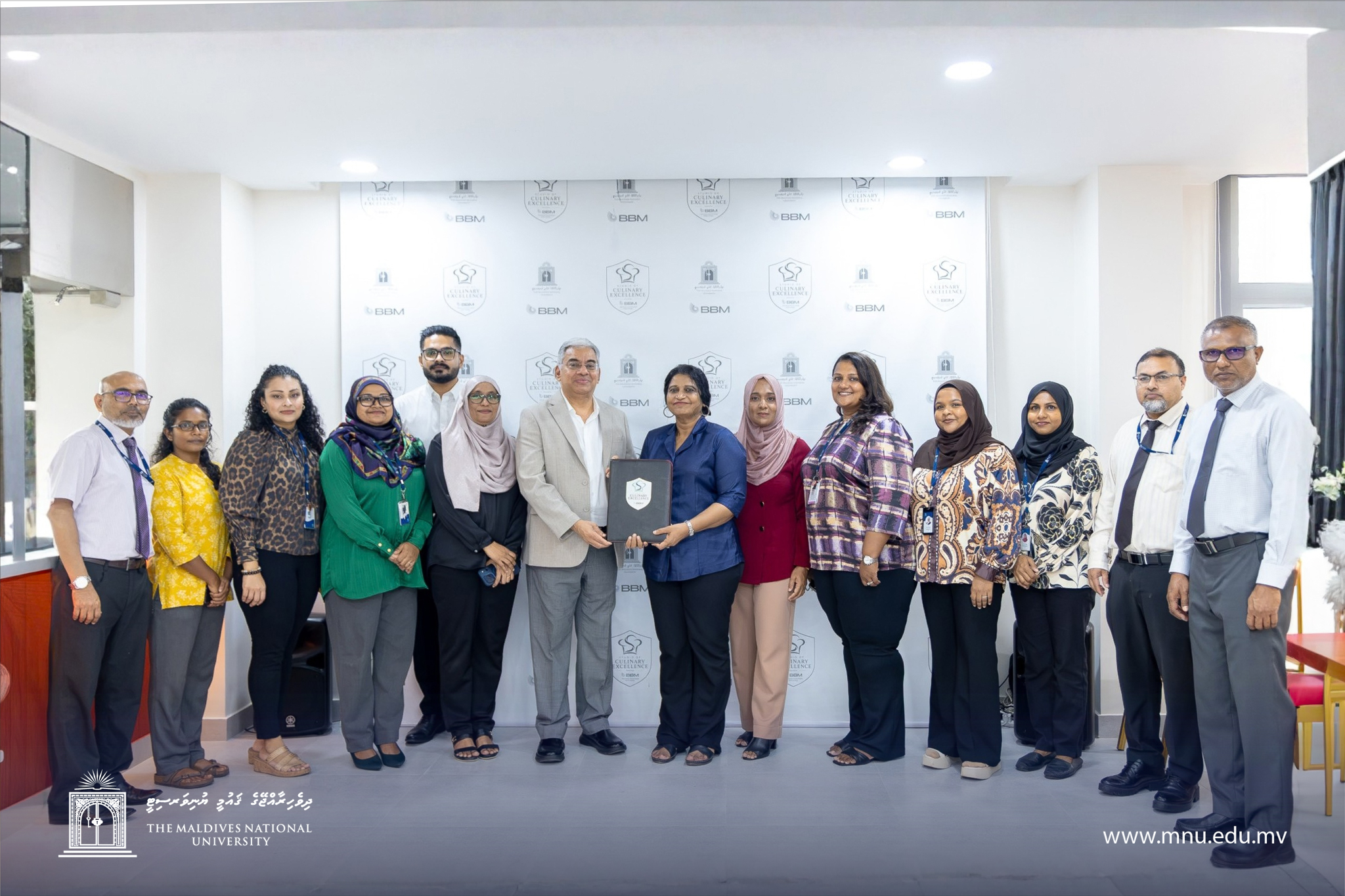
It is firmly in this context that Mr Ismail Hilmy, Chairman and Managing Director of BBM, initiated the establishment of a modern, exceptionally well-equipped and thoughtfully designed model kitchen, aptly named the Studio of Culinary Excellence. By donating the Studio to MNU, under whose auspices it will serve the Maldivian culinary community, Mr Hilmy is responding directly to the need for deeper community engagement. At the heart of BBM’s framework for industry-outreach initiatives— “Because tomorrows start today”—is Mr Hilmy’s ethos of fostering engagement and vibrancy in the industry.
“For our students, the gap between the classroom and a working resort kitchen has always been the hardest one to close,” said Dr Shehenaaz Adam, Vice Chancellor of the Maldives National University. “The Studio of Culinary Excellence closes that gap. Students can now train on the same equipment and to the same standards they will encounter on their first day in the industry. We are grateful to BBM for a partnership that goes well beyond a donation, and we look forward to the Studio becoming a place where the university and the industry learn from one another.”

The Studio therefore creates an opportunity to develop a pipeline of skills and talent in service of the industry.
“Embedding purpose in our work has been an ongoing endeavour at BBM. It keeps us connected to our stakeholders and builds insight, understanding and trust. Being a meaningful partner to academia as we move into the future gives us a great sense of fulfilment and guides our initiatives under the banner, ‘Because tomorrows start today,’” said AVS Subrahmanyam, Chief Operating Officer of BBM.
But what is the value of physical infrastructure without the corresponding spark of aspiration and ambition?

As Ali Afrah Hassan, Executive Representative at Chairman’s Office – BBM, aptly observed: “The Studio offers students and members of the community hands-on experience with world-class equipment, together with knowledge-sharing masterclasses. Who knows—in the not-too-distant future, a Michelin-starred Maldivian chef may fondly credit some of their inspiration to time spent at the Studio!”
Now that is the mind and heart in sync—working towards a future that is aspirational, ambitious and entirely attainable.

-

 Cooking1 week ago
Belgian Chef Wout Bru to bring exclusive dining experiences to Meyyafushi, Fushifaru Maldives
-

 News1 week ago
.Here Baa Atoll completes two-island concept with opening of Nowhere Private Island
-

 Cooking1 week ago
Award-winning Pastry Chef Elena Nabiullina brings contemporary pâtisserie to The Nautilus Maldives
-

 News1 week ago
Patina Maldives announces Orthodox Christmas celebrations with Russian cuisine and live entertainment
-

 News1 week ago
Six Maldives spas operated by Mandara Spa recognised in global top 100 list
-

 Action1 week ago
Adaaran Select Hudhuran Fushi brings together 40 women for surfing, wellness retreat
-

 Cooking1 week ago
Barceló Nasandhura Malé partners with Ministry of Crab for rooftop dining experience
-

 News1 week ago
COLOURS OF OBLU reveals festive experiences for families and couples across four resorts