

Featured
The Maldivian ‘new normal’


By Sonu Shivdasani
It has been a torrid few days in the Maldives’ battle against Covid-19: we’ve seen spikes in new cases and, unfortunately, the country’s first victim. In much of the rest of the world, though, the news has been more positive. Many countries, which are also big tourism markets to the Maldives, have flattened the curve and slowly started opening back up.
Life is starting to resemble a sort-of-normal in places such as Austria, Switzerland and Germany (although there is still no date for when international borders will reopen). Hopefully, the Maldives will flatten its curve over the next couple of weeks and bring the virus outbreak under control. This begs the question: what might the ‘new normal’ look like here?
There are many unique aspects to the virus. One of the most unexpected relates not to epidemiology, but to politics. In every global crisis since the Second World War, the United States led the global recovery effort. But under President Trump, America has turned its back to the world, and shunned international co-operation. Under Obama or Bush, the world could have sat back and allowed the superpower to lead efforts to combat the virus, and set international protocols about air travel and reopening borders. In the absence of US leadership, the Maldives, alongside everyone else, will have to figure this out on their own.
With travel and tourism accounting for a huge slice of the Maldivian economy and generating most jobs, clearly a ‘new normal’ has to include the re-opening of the country to tourists. But how can this be done safely?
We will have to work closely with other countries and organisations. This means striking bilateral agreements with our major tourism markets in Western Europe, India, and China, as well as working with international tourism bodies such as the United Nations World Tourism Organisation (UNWTO) to establish a way forward. One of the tricky issues will be establishing new protocols on how people can travel, how they are screened upon arrival, and how they can avoid the requirement to quarantine for two weeks when they return home.
For the Maldives, testing and screening passengers upon arrival and departure will have to become part of our new normal; it is difficult to see how we can reopen safely without it. This will pose challenges and require strict new protocols at the airports, but testing will become progressively easier as test kits become quicker, cheaper, and more reliable.
Hygiene will become a major consideration, or ‘qualifier’, for holidaymakers. Nobody wants to stay in a dirty hotel room, but in the Covid-19 era, hygiene will take on a whole new meaning. Travel and tour operators will compete fiercely on providing a safe, hygienic holiday, where social distancing can be maintained. Last week brought news of a partnership between Bureau Veritas, a testing, inspection and certification company, and Accor, a major hotel chain, which will establish standards for hygiene in hotel operations.
Other hotel companies are bound to follow suit, tying up with inspection agencies in order to reassure would-be travellers that their hotel rooms, restaurants and communal areas are properly sanitised, and the property isn’t overcrowded.
In an era where guests are as preoccupied about safety and hygiene as they are about the quality of the food, Maldivian resorts are well placed. The country is one of the few to operate a policy of ‘one island one resort’ – a geographic advantage that makes it much easier to prevent and contain a coronavirus outbreak, because each resort can strictly control who steps onto their island. In fact, the English word ‘isolation’ and the Italian ‘isola’ both derive from the Latin ‘insula’, which means island. Island = isolation. Perhaps the country’s tourism strapline, “The Sunny Side of Life” needs to change to reflect the safe, isolated nature of its resorts.
At Soneva, we’ve been thinking through our own ‘new normal’. We believe that customers’ fears over safety will be allayed by a rigorous new testing regime. Soneva plans to give everyone who arrives at our resorts a quick coronavirus test. After completing the test, guests will be escorted straight to their villa, or staff to their host accommodation, until the result comes through. If the test is negative, the guest or host can carry on as normal. If the test is positive, we will follow government rules, which likely means moving people to an isolation facility – which are fortunately some of the world’s most luxurious, located in resorts.
If such a testing policy was introduced across the Maldives, it will reassure tourists that the country is safe to visit, and also reduce the likelihood of future virus outbreaks. Robust testing also provides the Maldives with the opportunity of creating something truly unique: virus free resorts.
By testing everyone who comes onto an island, we can ensure that everybody on it is clear of the virus. This would render social distancing, and no-touching rules, unnecessary within that particular island. Maldivian resorts could thus transport guests back to the heyday of 2019, without constant coronavirus reminders spoiling their holiday. This could be a major ‘differentiator’ for Maldivian tourism compared to other holiday destinations.
For the rest of the world, largely made up of bigger countries adjoined to each other by land borders, it is almost impossible to create virus-free havens. The threat of infection will always lurk in the building across the street, the hotel staff who travel to work each morning on crowded public transport, or from the neighbouring country with a porous border.
The ‘new normal’ in the Maldives will be different to the normal life we enjoyed before Covid-19. But the country remains extremely lucky because of its unique geography. If the right testing protocols are established, the Maldives will enjoy a significant competitive advantage – something that could underpin its future prosperity, even during these troubled and turbulent times.
Editor’s Note: This op-ed was originally published on Linkedin by Sonu Shivdasani. Sonu is the founder and CEO of Soneva, which owns luxury resorts Soneva Fushi and Soneva Jani in the Maldives, and Soneva Kiri in Thailand.


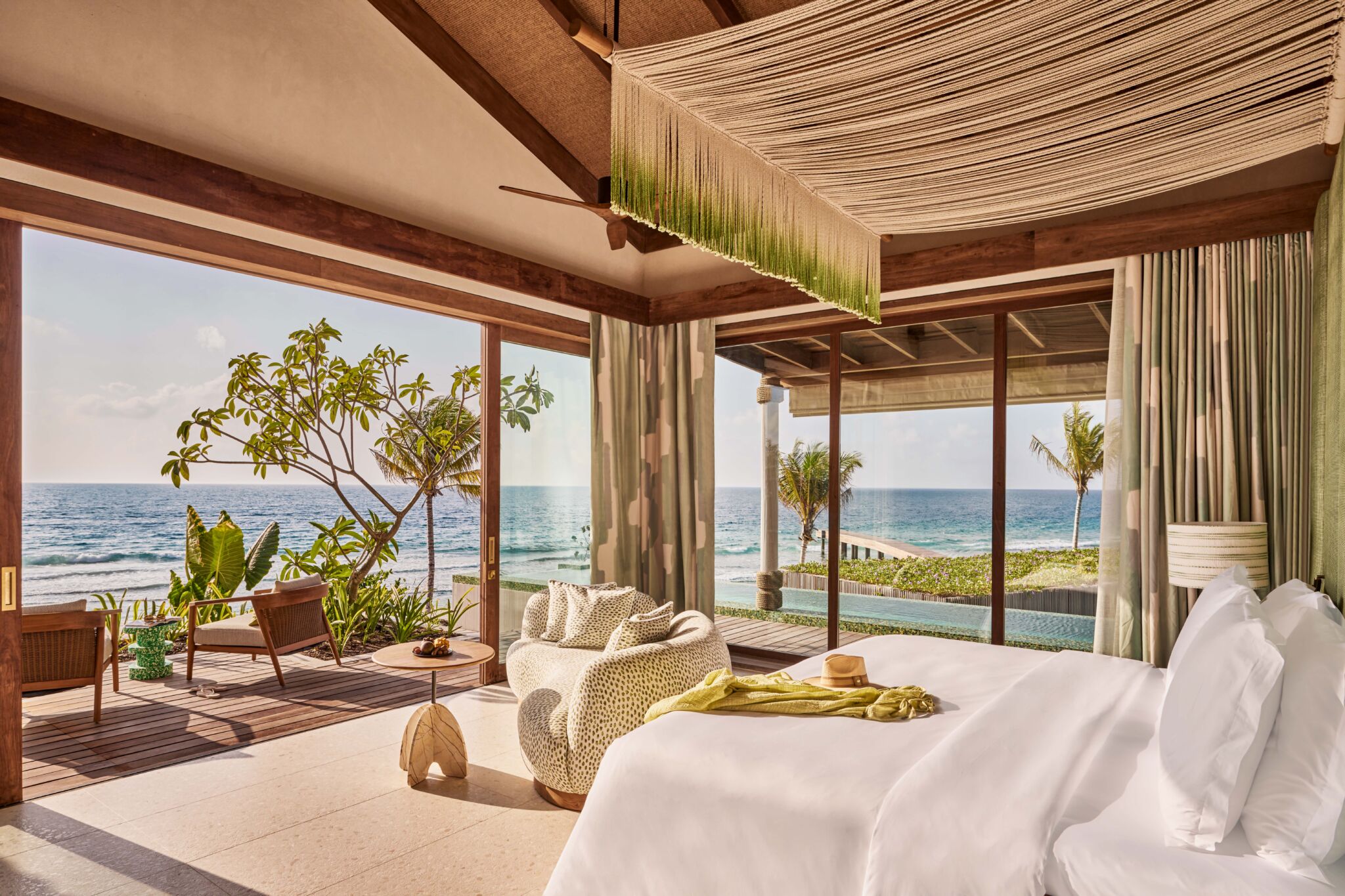
.Here Baa Atoll, a private island retreat in the Maldives, has been named the No. 6 Resort in the Indian Ocean in the Condé Nast Traveler Readers’ Choice Awards 2026.
The annual Readers’ Choice Awards recognise hotels, resorts, destinations, airlines and other travel experiences based on votes submitted by Condé Nast Traveler readers.
The recognition places .Here Baa Atoll among the highest-ranked resorts in the Indian Ocean and comes during a milestone year for the property.
Located within the UNESCO Biosphere Reserve of Baa Atoll, .Here Baa Atoll comprises nine residences spread across two natural islands, Somewhere and Nowhere.
Somewhere features seven three- and four-bedroom residences extending from the beach towards the lagoon and designed for families and groups travelling together. Each residence offers indoor and outdoor living spaces, multiple pools, private dining and personalised Roohu service. Guests are transferred directly to their residence by private speedboat, avoiding a conventional lobby and check-in process.
Condé Nast Traveler has previously highlighted the resort for its emphasis on privacy, its beach-to-lagoon residences and its discreet approach to luxury.
The resort experience also includes Nowhere Private Island, which is reserved exclusively for a single group at a time. The island features a five-bedroom Presidential Residence and a three-bedroom Lagoon Residence, providing eight bedrooms and 3,329 square metres of private living space, supported by dedicated service and individually curated experiences.
The Readers’ Choice Award follows several other recognitions received by .Here Baa Atoll during 2026. The resort was included in the Condé Nast Traveler Hot List 2026, with the publication highlighting its residences and design. It has also received international recognition for its architecture and design, alongside creative collaborators Kulör Group, Muza Lab and Topo Design Studio.
Elina Adiyan, Resident Manager of .Here Baa Atoll, said: “To be recognised by the readers of Condé Nast Traveler so early in our journey is incredibly meaningful. .Here was created around a simple idea: to give guests extraordinary space, genuine privacy and the freedom to experience the Maldives entirely on their own terms. This recognition belongs equally to our team, whose care and dedication bring that vision to life every day. We are deeply grateful to everyone who voted for us.”
The latest recognition adds to .Here Baa Atoll’s growing international profile within the luxury travel sector, with the resort positioning privacy, spacious accommodation, design and personalised service at the centre of its guest experience.
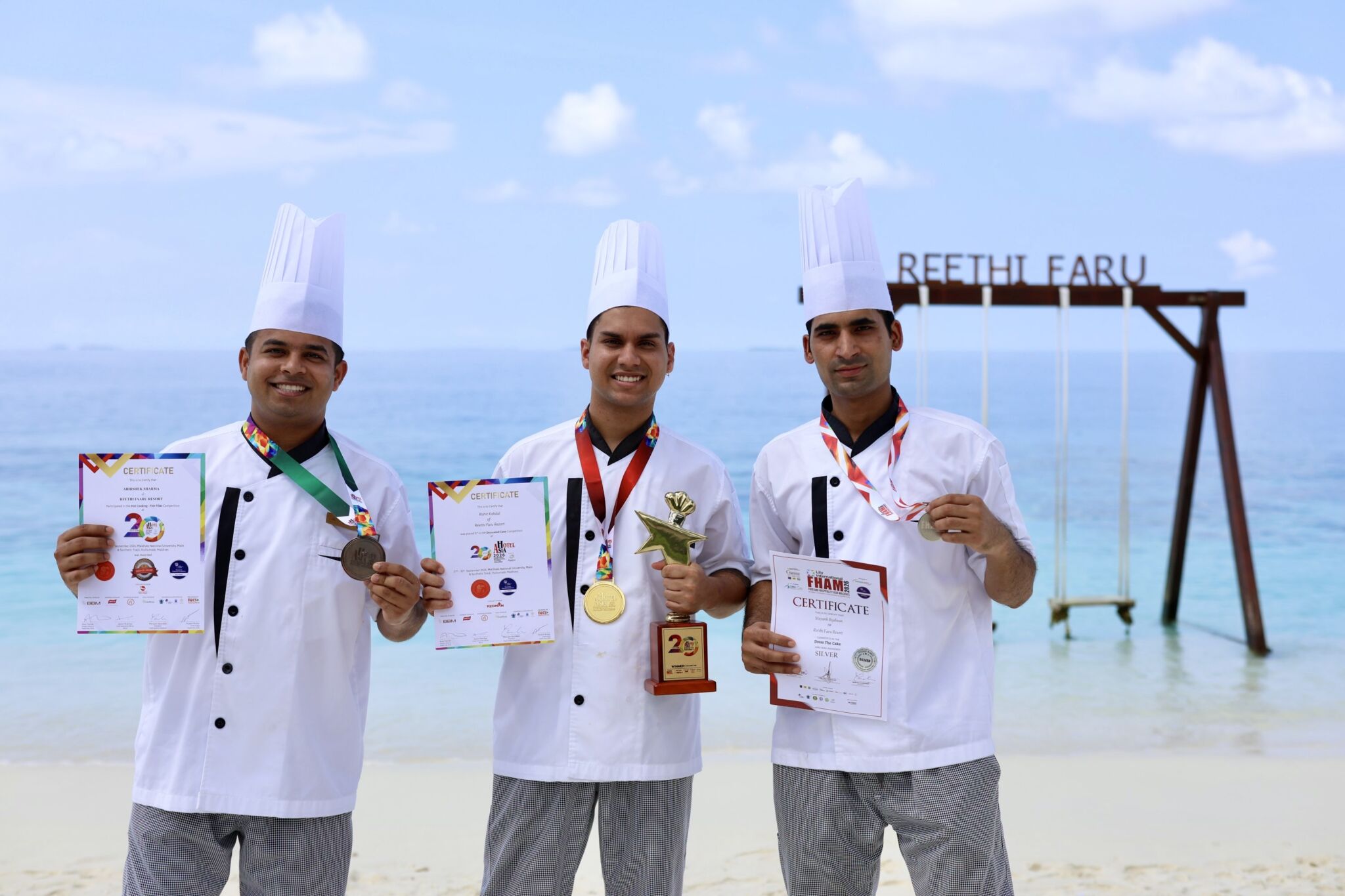
Reethi Faru Resort has announced three medal wins by members of its culinary team at the Hotel Asia Culinary Challenge and the FHAM Global Culinary Challenge.
At the Hotel Asia Culinary Challenge, Chef Rohit Kabdal received a Gold Medal in the Decorated Cake category, recognising his work in cake design, presentation and technical execution.
Chef Abhishek Sharma also represented Reethi Faru Resort at the competition, earning a Bronze Medal in the Hot Cooking Fish category.
At the FHAM Global Culinary Challenge, Chef Mayank Bijalwan secured a Silver Medal in the Dress the Cake category, adding a third medal to the resort’s recent culinary achievements.
The results highlight the range of skills within Reethi Faru Resort’s culinary team, spanning pastry, cake presentation and hot kitchen techniques.
According to the resort, participation in professional culinary competitions provides its chefs with opportunities to develop their skills, exchange knowledge and test their abilities alongside other industry professionals.
The achievements also form part of Reethi Faru Resort’s wider focus on dining and guest experience, with its culinary team involved across the resort’s restaurants and food and beverage offerings.
Reethi Faru Resort congratulated Kabdal, Bijalwan and Sharma on their respective achievements, describing the results as recognition of their commitment, technical ability and creativity.
The three medals add to the resort’s recent culinary accolades and reflect its continued emphasis on professional development within its kitchen team.
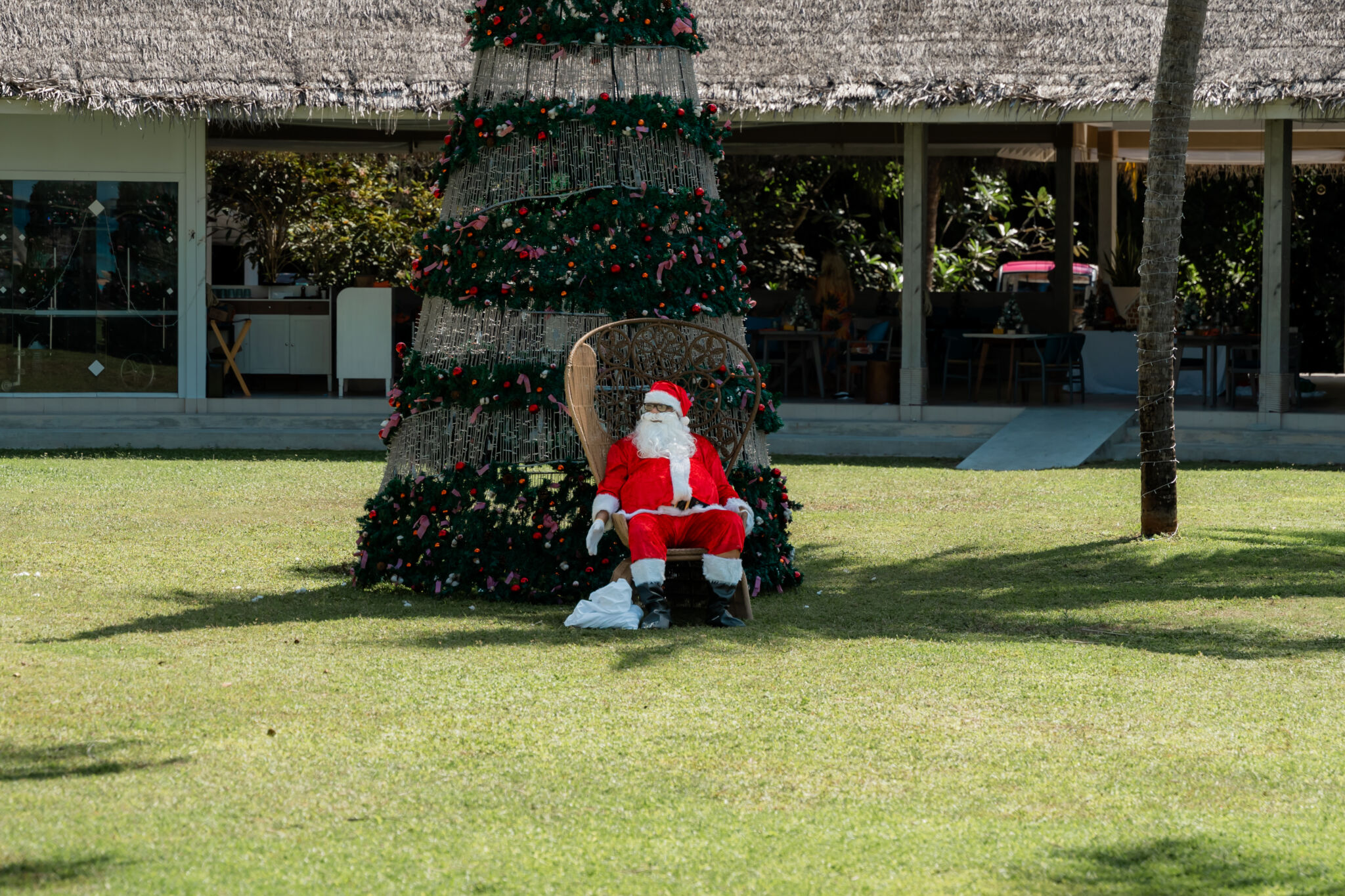
Ifuru Island Maldives will celebrate the 2026 festive season with “Echoes of the Ocean and Stars”, an immersive Christmas and New Year programme running from 21 December 2026 to 10 January 2027.
Inspired by the natural beauty of the Maldivian ocean, the night sky and the festive season, the theme will bring together marine and celestial elements across the resort’s décor, entertainment, dining, activities and guest experiences.
At the centre of the concept is the idea that the ocean carries memories, while the stars represent dreams and new beginnings. Rather than presenting the festive season as a series of standalone events, Ifuru Island plans to create a connected journey spanning Christmas, New Year and Orthodox Christmas.
The visual identity of “Echoes of the Ocean and Stars” will combine an underwater-inspired world with celestial elements. Bioluminescent-inspired colours, reef motifs and glowing details will be paired with stars, constellations and moonlit features throughout the resort.

The colour palette will include deep ocean blue and midnight navy alongside pearl white, silver, soft turquoise, pink and purple, with accents of celestial gold. Coral forms, waves, shells and reef-inspired features will be combined with stars and festive details, giving traditional Christmas elements an interpretation inspired by Ifuru Island’s natural surroundings.
The concept will extend beyond decorations to dining, entertainment, activities, uniforms, signage and festive communications.
The resort said the theme is also intended to reflect the emotions associated with the festive period. The ocean represents peace, connection and possibility, while the stars symbolise hope, dreams, guidance and new beginnings.
The festive journey will begin on 21 December and continue through 10 January, encompassing Christmas, New Year and Orthodox Christmas celebrations.
Christmas Eve on 24 December will feature festive dining and entertainment, while Christmas Day on 25 December will centre on family celebrations and relaxed island experiences.
On 31 December, Ifuru Island will mark New Year’s Eve with the main celebration of the festive period, before welcoming 2027 on New Year’s Day with activities centred around the island setting and surrounding ocean.

Celebrations will continue from 1 to 10 January during the Orthodox festive period, including Orthodox Christmas.
According to the resort, the broader concept is intended to connect the entire guest experience, with the island’s natural environment forming part of the festive setting. The ocean will provide inspiration during the day, while the night sky will shape the atmosphere after sunset.
Dining experiences, entertainment and activities will each form part of the wider “Echoes of the Ocean and Stars” narrative, giving guests different experiences throughout their stay while maintaining a consistent creative theme.
The programme is designed for guests travelling with family, friends or loved ones, with Ifuru Island aiming to combine its natural surroundings with festive celebrations and shared experiences.
The full festive programme, including entertainment, activities, culinary experiences and special events, will be announced separately.
“Echoes of the Ocean and Stars” will run at Ifuru Island Maldives from 21 December 2026 to 10 January 2027. Christmas Eve will be marked on 24 December, Christmas Day on 25 December, New Year’s Eve on 31 December, New Year’s Day on 1 January and the Orthodox festive period from 1 to 10 January 2027.

-

 News7 days ago
50 visits, hundreds of dives: Bandos Maldives honours loyal guests with coral garden
-

 News1 week ago
Coco Bodu Hithi invites guests to make memories with ‘Island Glow’ festive season
-

 Cooking1 week ago
Park Hyatt Maldives Hadahaa announces six-chef Masters of Food & Wine series
-

 News1 week ago
Sun Siyam Iru Fushi builds more into the stay with expanded guest inclusions
-

 Cooking1 week ago
Park Hyatt Milan’s Chef Joshua Acquaviva heads to Alila Kothaifaru Maldives
-

 News1 week ago
Adaaran Select Meedhupparu celebrates Maldivian heritage at festive cake mixing ceremony
-

 Awards1 week ago
RAAYA by Atmosphere wins Best Family Resort in Maldives at Travel Time Awards 2025
-

 Cooking6 days ago
V Villas Maldives at Mirihi brings Thai flavours from Phuket to the Maldives