

Action
Authentic Traditional Souvenirs of Maldives


 Since the beginning of tourism in Maldives during the 1970’s the local crafts have gained a vast popularity among tourists. The various crafts and handiwork of Maldivian craftsmen have always intrigued travelers from all over the world. However over time the magnificent works of art has fallen victim to rising tides of cheap imitations and unauthentic replicates. While this may be due to the high production costs from traditional methods, when applied to large scale production, unauthentic products cannot even come close to the real ones in both beauty and uniqueness. Souvenir shops in the city and in islands usually trade both cheap imports and original local handicraft. For travelers it is vital to know that what they are paying for is authentic works of art.
Lacquer works

Also known as “Liye Laajehun”, Maldivian lacquer works are and always has been a magnificent art which has produced creative designs that have survived through the Maldivian history. Since ancient times, the techniques have been applied to create vases, jewelry boxes, and kitchen utensils of fabulous beauty, for the royals of Maldives.
It is a highly decorative art carried out by skilled artists in which lathes are used to paint layers of colored lac over shaped wood. Usually the artist starts with a bright color and ends with a dark color such as black. The artist then uses a sharp tipped object to carve designs exposing the bottom layers. A finishing polish is applied and the work is ready for use.
Dhoni crafts
 Dhonis or sail boats are a major invention of Maldivians as they were the first modes of transportation among Maldivians. They are designed to withstand the vigor of the oceans and to provide swift motion. Crafting of miniature models of these ancient works of art is known as Dhoni crafting.
Such models of varying sizes and quality are available in Maldives. Maldivian artists use timber which is carved into models that represent the ancient vessels. The parts are polished and varnished before they are constructed into models.
Wood carvings
 Due to the remoteness and abundance of plants in Maldives, ancient natives used wood from the trees to create objects to optimize their work and fulfill their needs. Objects such as kitchen utensils and containers were carved from wood. The carvings are sometimes polished and can represent magnificent designs.
Wood carving has evolved to create works of art such as miniature models that represent the early Maldivians and their culture. These wood carvings are sometimes painted and sometimes subjected to lacquer work. Carvings of images and text into wood was also carried out by early Maldivians. Traditional Maldivian mosques have large wooden planks with text carved into them.
Mat weavings
 Mats or “Kunaa” were vital to the early natives. They were mostly used for seating and sleeping among other uses. Mats have also been delivered as royal gifts by the Maldivian Sultans. The artistic designs created during the weaving are still comparable to modern textures. However the technique used is very simple and mostly it is just the creativity of the weaver that produces astonishing designs.
Screw-pine leaves are collected and dried in the sun. Natural dyes are then used to dye them into three basic colors, black, brown and yellow. A simple loom and a knife are used to slit screw-pine leaves to produce the varying patterns on the mat.
Coconut shell products
 Coconut is one of the most abundant fruits in Maldives. It is one of those fruits that can be used during all stages of its maturation. In fact the coconut palm, one of the most abundant palm trees in Maldives, is the Maldivian national tree and has been used for multiple purposes throughout history.
The trunks are used for timber while the husks are used to make coir ropes.The leaves are used for weaving mats and creating thatching for roofs. The eakles are used to create brooms. The shell is cleaned, dried, and polished, before it is used to create ornaments or other works of art. “Raa Bandhi” is a container created from two coconut shells joined to increase capacity. It is used to collect and store toddy from coconut palms.
Coir ropes
 Coir Ropes are an important part of Maldivian civilization, as they have multiple purposes. They were extremely important to early Maldivians during the building of huts and construction of sailing vessels and hammocks. Ancient Maldivians chose the coconut husks as it is a strong material as well as an easily available resource.
The coconut husks are soaked for about two or three weeks by burying them in the beach. They are then pounded and beaten into fibers which are washed and sun dried. They are then hand rolled and woven into ropes of different sizes. The coir ropes or “Roanu” are now mainly used in ornamental purposes.


Action
From zero experience to professional careers: Atmosphere Foundation celebrates Divemaster graduates

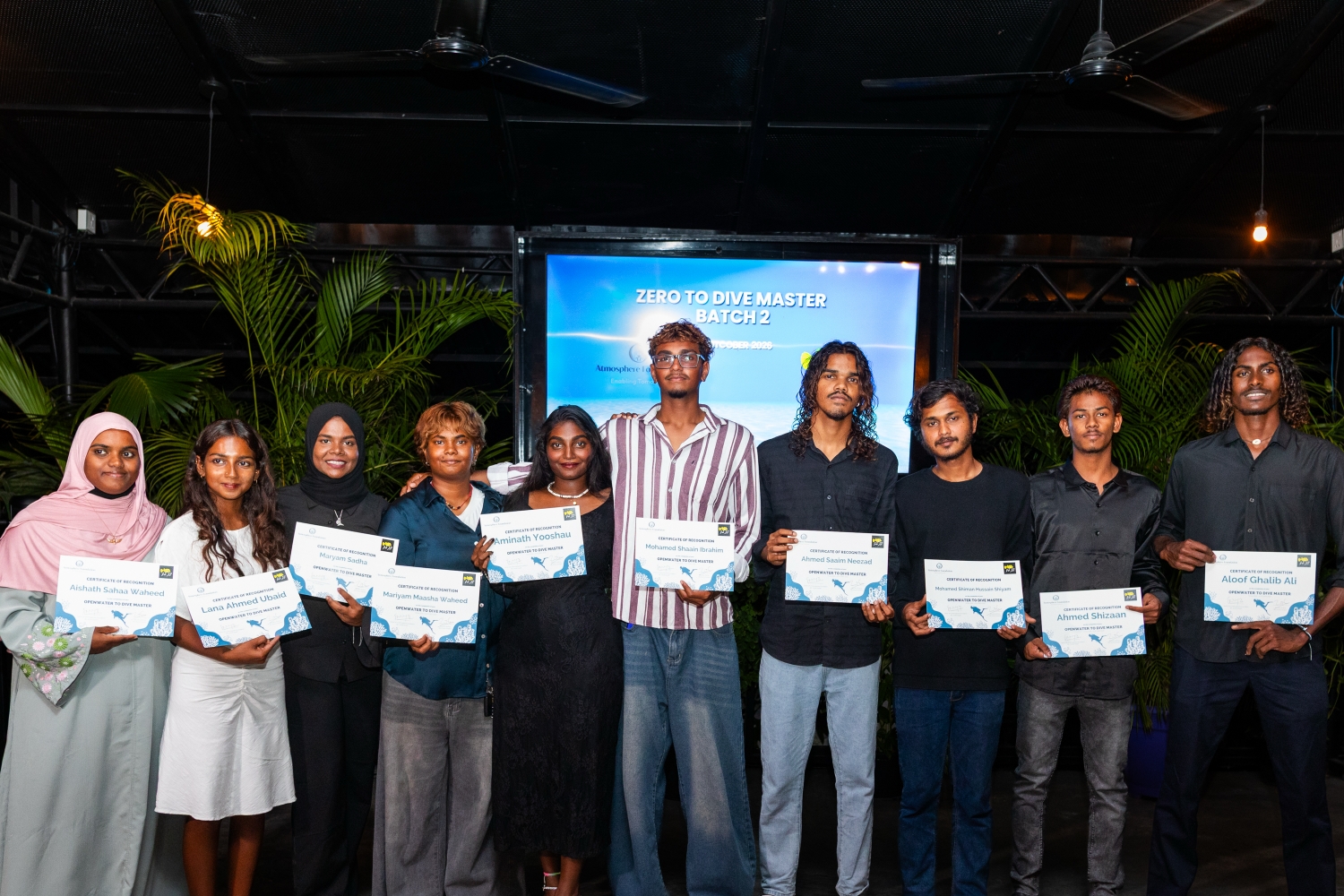
Atmosphere Foundation has celebrated the graduation of the second batch of its ‘Zero to Divemaster’ Scholarship Programme, bringing the total number of young Maldivians trained through the initiative to 20 as the Foundation continues to build pathways into professional careers in the country’s diving industry.
Ten participants completed the second batch of the three-month programme, which takes students through a structured training pathway from PADI Open Water Diver to Advanced Open Water Diver, Emergency First Response, Rescue Diver and, ultimately, professional Divemaster certification.

Delivered in partnership with Moodhu Bulhaa Dive Centre in Vilimalé, the programme is designed to enable Maldivians to enter the professional diving industry even without previous diving experience. The second batch, comprising five women and five men, began training in July following the completion of the inaugural cohort.
The latest graduation builds on strong outcomes from the first batch, which began in April 2026 with 10 participants. All 10 successfully obtained their professional Divemaster certifications, while nine have since secured employment across safari vessels, resorts and island-based dive centres.

The 90 per cent employment rate among the first batch highlights the programme’s success in translating professional training into direct employment opportunities within the Maldives’ tourism and marine sectors.
Beyond technical diving skills, the programme provides participants with training in safety, emergency response and the responsibilities associated with working as a professional Divemaster. The progressive training structure is intended to equip graduates with both the qualifications and practical competencies required to work in professional diving environments.
A key component of the initiative is the level of financial support provided to scholarship recipients. Atmosphere Foundation covers tuition, required certification and registration fees, while also providing accommodation and meals during the programme. The scholarship for the second batch additionally covered training materials and dive insurance, helping remove financial barriers that could otherwise prevent participants from pursuing professional diving qualifications.

By covering both the cost of training and participants’ day-to-day living requirements during the course, the programme allows scholarship recipients to focus on developing their diving skills and completing the demanding progression towards Divemaster certification.
The programme also links scholarship support with a longer-term commitment to the Maldives. Participants agree to work within the country’s diving and marine industry for at least two years after successfully completing their certification, helping ensure that the skills developed through the initiative contribute directly to the local workforce.
With diving forming an important part of the Maldives’ tourism industry, the initiative seeks to expand opportunities for Maldivians to develop specialised skills and pursue careers in an area where trained professionals are required across resorts, liveaboards and local dive centres.

The results of the first cohort provide an early indication of the programme’s potential. While only three graduates had secured jobs when the second batch was launched in July, that figure has since increased to nine, reflecting continued progression into employment following certification.
Following the completion of two batches, Atmosphere Foundation has confirmed that the Zero to Divemaster Scholarship Programme will continue, providing further opportunities for Maldivians seeking to enter the professional diving industry.

With 20 participants now having completed the programme across its first two cohorts, Zero to Divemaster is developing from a training initiative into an employment pathway, combining internationally recognised diving qualifications with practical skills, financial support and a direct connection to career opportunities within the Maldives.
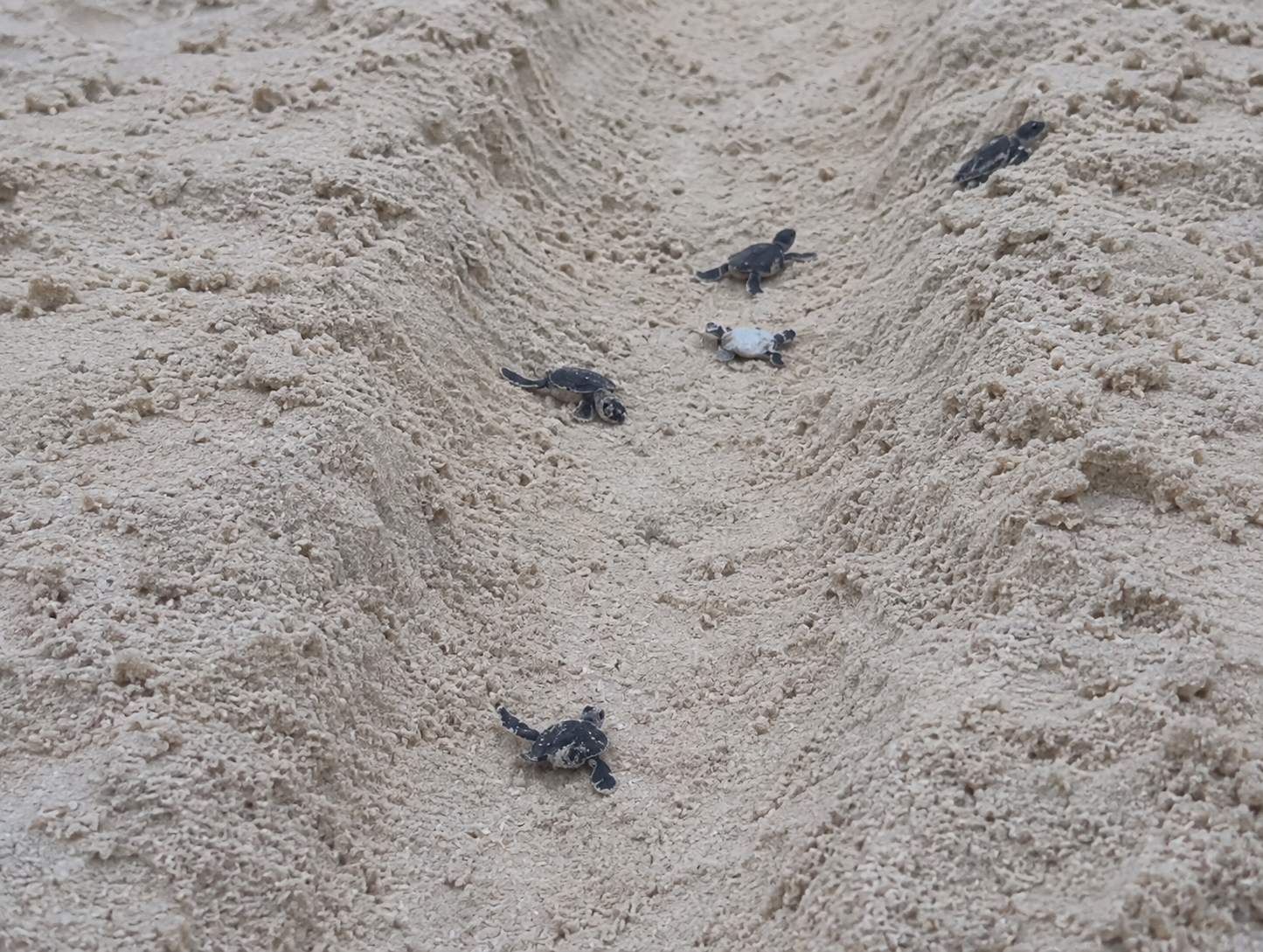
At Cinnamon Velifushi Maldives, seven sea turtle hatchlings recently emerged from the sand and made their way towards the Indian Ocean, their tiny flippers carrying them across the beach before disappearing into the blue. It was a fleeting moment, but one that offered a beautiful reminder that the beaches of the Maldives are more than places to escape to. They are living environments where some of the ocean’s most extraordinary stories begin.
For a sea turtle hatchling, the distance between nest and ocean may be measured in metres, but it marks an important first chapter in a much longer journey.

Sea turtles nest throughout the year in the Maldives, with nesting activity recorded across almost all of the country’s atolls. Green turtles account for the majority of recorded nests, while hawksbill and olive ridley turtles have also been documented. Recent research into nesting activity in the Maldives found that nests typically take around two months to hatch.

Once they emerge, however, the hatchlings are immediately faced with a challenging journey. Their instinctive movement towards the ocean is one of the most vulnerable stages of their lives. Natural predators are only part of the challenge. Artificial lighting can disorient hatchlings and lead them away from the water, while pollution, fishing activity, habitat loss and the effects of climate change continue to present threats throughout their lives.
Surrounded by the waters of Vaavu Atoll, Cinnamon Velifushi Maldives sits within a rich marine environment where encounters with the natural world extend far beyond the shoreline. The waters around the atoll are home to an abundance of marine life, from colourful reef fish and rays to sharks, dolphins and sea turtles, making the ocean an ever-present part of the island experience.

At Cinnamon Velifushi Maldives, these seven hatchlings were only visitors for a matter of minutes before the ocean carried them away. But for those fortunate enough to witness their first journey, they left behind something much bigger: a reminder that in Vaavu Atoll, some of the Maldives’ most memorable experiences are the ones nature chooses to create itself.
Pullman Maldives Maamutaa continues its ongoing marine conservation journey with the identification of Six Individual Indo-Pacific Leopard Sharks along the resort’s house reef. The sharks were documented through photographic observation and submitted to the MIYARU, the Maldives’ national non-profit organisation and research network focused on collaborative shark research and conservation.
The six identified sharks namely Atlas (LS081), Aurelian (LS083), Kikongo (LS090), Ambala (LS091), Ingwe (LS096), and Fowler (LS097) – can each be recognized by their distinctive patterns of dots and spots. Similar to a human fingerprint, these natural markings are unique to every shark, enabling marine researchers to identify individuals when they are encountered again.

By documenting these individual sharks, Pullman Maldives Maamutaa is contributing to a growing body of knowledge about the species and how it uses local reef habitats. Each sighting adds another piece to the wider picture of leopard shark presence and movements in the Maldives, supporting continued awareness, research and conservation.
For Pullman Maldives Maamutaa, conservation is about creating meaningful connections with the natural world. From a passing encounter with a leopard shark to learning how individual animals can be recognized beneath the surface, every discovery can offer a new perspective on the living reef.

The identification of these six leopard sharks reflects the resort’s continued approach to marine conservation through attentive observation, responsible marine experiences and collaboration with conservation partners.
As monitoring continues, Pullman Maldives Maamutaa invites guests to discover its house reef not simply as a destination beneath the surface, but as a living environment shared with an extraordinary diversity of marine life.
With every sighting, every photograph and every new record, the resort continues to build a deeper understanding of the waters surrounding Maamutaa – inspiring greater appreciation for the wildlife that calls the Maldives home.

Kayla Shortt is Pullman Maldives Maamutaa’s in-house Marine Biologist and PADI IDC Staff Instructor, who coordinated the in-water observations, photographic documentation and identification submissions that resulted in the six individual records.
Originally from South Africa, she has worked across five-star resorts in the Maldives since 2021, bringing together her experience in marine tourism and practical conservation.

Her expertise spans reef-health monitoring, turtle rehabilitation and shark behavior, with a particular focus on creating greater awareness and understanding of the marine environment.
At Pullman Maldives Maamutaa, Kayla makes marine science engaging and accessible, connecting guests with the underwater world while supporting the resort’s ongoing conservation efforts. Through her work, she contributes to a deeper understanding of the Maldives’ marine environment and the remarkable wildlife that calls it home.

-

 News1 week ago
‘The Curse of the Vigani’ takes over Oaga Art Resort this Halloween
-

 News1 week ago
InterContinental Maldives marks brand’s 80th anniversary with Michelin-starred culinary collaboration
-

 News1 week ago
Soneva’s Maldives waterslide reimagined as contemporary art in Stockholm
-

 Awards1 week ago
Baros Maldives wins Indian Ocean’s Leading Water Villa Resort at World Travel Awards
-

 Awards1 week ago
Kuda Villingili Resort earns highly commended honour at Family Traveller Awards
-

 News1 week ago
Cora Cora Maldives welcomes guests back after planned island enhancements
-

 News1 week ago
Fushifaru Maldives unveils five-day celebration for ninth anniversary
-

 Love1 week ago
25 years later, Frank and Heike say ‘I Do’ underwater at Villa Nautica