

Business
UN body suggests tax breaks, operational changes to soften blow on virus-hit Maldives tourism workers


Authorities in Maldives should provide tax incentives to tourism businesses and restructure the existing model of resort operations to minimise the impact on people employed in the island nation’s main economic sector, a UN body has said.
In an assessment of the impact of the coronavirus pandemic on the tourism industry, UNDP recommended the government to review tourism taxes, charges and fines.
The government should also defer payments, so that resorts can manage cash flow and retain employees until operations are back to normal, it said.
“The financial relief package should have specific mitigation packages to stimulate demand, to retain jobs, incentivise and protect the most vulnerable people and sustain the self-employed,” the report read.
“Tax incentives should prioritise those resorts that are achieving full retention of employees, those that will invest in skill development of Maldivians in the resort work force and those that invest in diversifying the workforce to include women’s participation.”
The government had already deferred lease rent payable by resorts for the rest of the year.
Reduce on-site living
Meanwhile, UNDP recommended the government to take steps to restructure the existing resort operation model in the ‘new normal’ and identify emerging employment opportunities within this alternative model.
The government was asked to reduce onsite employee living by establishing living and commuter facilities between resorts and neighbouring inhabited islands.
“Businesses and the government can jointly invest in developing selected islands in a given atoll with housing/accommodation, schooling, day care health and training facilities for resort employees and their families. This can unlock employment opportunities for those with barriers to on-site resort living such as women,” the report said.
“Investments in employee families can help to increase motivation, productivity and minimise employee turnover for resorts. This new model will be conducive to managing health and safety standards, social distancing and exclusivity of resorts for visitors.”
UNDP also suggested that the government look into ways to take operational aspects of resorts such as human resource management, procurement and purchasing, finance, administration and reservations online.
“By taking these departments online, resorts can minimise on-site employees, increase productivity and engage more diverse groups in employment including women and persons with disabilities that have barriers to living onsite,” the report said.
What has been done so far?
An MVR 2.5 billion stimulus plan, announced in March, includes MVR 1.55 billion ($100 million) in emergency loans for businesses to meet short-term working capital needs.
Under the government’s stimulus plan, emergency loans for businesses with an annual turnover of less than MVR 10 million ($649,000) and self-employed individuals are arranged through the SME Development Finance Corporation (SDFC), a state-owned financial institution exclusive for small and medium enterprises.
Emergency loans for resorts as well as local businesses with a turnover of over MVR 10 million are arranged through Bank of Maldives (BML).
Both SDFC and BML are accepting applications for the emergency finance.
The unsecured loans by BML and SDFC come with a six-month grace period and a repayment period of three years. Interest is charged at six per cent per annum, but no interest is charged during the grace period.
The government initially mandated all businesses that avail the emergency finance to retain their local workforce and pay salaries.
However, the government has since relaxed the eligibility criteria to give “a second chance” to businesses that failed to secure the finance in the first round of applications.
Under the relaxed rules, businesses that agree to rehire axed local employees and give a monthly salary of at least MVR 5,000 ($322) will qualify for the emergency loan scheme. Those that pledge to ensure employee pay will not fall below MVR 5,000 can also apply. =
In addition to the emergency finance, the government’s stimulus plan is complemented by a package of financial measures, including a six-month moratorium on principal and interest repayments for personal, business and housing loans sanctioned by commercial banks.
The government is also subsidising utility bills.
Those that lose jobs due to the coronavirus pandemic will also be paid unemployment benefit for a period of three months.
Meanwhile, the central bank has announced a $150 million facility for banks to ensure healthy foreign currency reserves.
The facility is arranged through a $400 million stand-by currency swap signed by the Maldives Monetary Authority (MMA) and Reserve Bank of India (RBI) last year, he said.
If required, minimum reserve requirement of banks will also be slashed from 10 to five per cent to allow banks to increase lending.
The coronavirus outbreak has hit the Maldivian economy hard, as travel restrictions and other preventive measures affect the country’s lucrative tourism industry, which contributes the bulk of the island nation’s state revenue and foreign reserves.
All international airlines have suspended scheduled operations to the Maldives, as the island nation enforced a blanket suspension of on-arrival visa in late March in a bid to combat the spread of the novel coronavirus.
Even before the visa suspension, the Maldives had closed its borders to arrivals from some of the worst-hit countries, including mainland China, Italy, Bangladesh, Iran, Spain, the United Kingdom, Malaysia and Sri Lanka. Visitors from three regions of Germany (Bavaria, North Rhine-Westphalia and Baden-Württemberg), two regions of France (Île-de-France and Grand Est) and two regions of South Korea were also banned from entering the country.
All direct flights to and from China, Italy, South Korea and Iran were also cancelled.
Cruise ships and foreign yachts were also banned from docking at any of the country’s ports.
With arrival numbers falling and the visa suspension in effect, several resorts across the Maldives had been closed.
Before the pandemic, the government had been bullish about tourism prospects, targeting two million, high-spending holidaymakers this year after last year’s record 1.7 million.
However, tourist arrivals saw a year-over-year decline of 22.8 per cent in the first 10 days of March. Officials say the number of tourist arrivals to the Maldives could drop by half in 2020.
Tourism has been the bedrock of the Maldives’ economic success. The $5 billion-dollar economy grew by 6.7 per cent in 2018 with tourism generating 60 per cent of foreign income.
However, the government is at present projecting a possible 13 per cent economic contraction this year — an estimated $778 million hit.
The Maldives is preparing to reopen its borders to visitors in July.
On March 8, Maldives reported its first cases of the novel coronavirus, as two hotel employees tested positive for Covid-19 at a luxury resort in the archipelago.
Eighteen more cases — all foreigners working or staying resorts and liveaboard vessels except five Maldivians who had returned from abroad — were later identified.
A six-case cluster of locals, detected in capital Male on April 15, confirmed community transmission of the coronavirus. Several more clusters have since been identified, bringing the total number of confirmed case in the Maldives to 1,901.
Eight deaths have been reported and 763 have made full recoveries.
The Maldives announced a state of public health emergency on March 12, the first such declaration under a recent public health protection law.
The public health emergency declaration has allowed the government to introduce a series of unprecedented restrictive and social distancing measures, including stay-at-home orders in capital Male and its suburbs, a ban on inter-island transport and public gatherings across the country, and a nationwide closing of government offices, schools, colleges and universities.
Non-essential services and public places in the capital such as gyms, cinemas and parks have also been shut.
Restaurants and cafes in the capital have been asked to stop dine-in service and switch to takeaway and delivery.
A nationwide shutdown of all guesthouses, city hotels and spa facilities located on inhabited islands is also in effect.
Photo: Mihaaru News


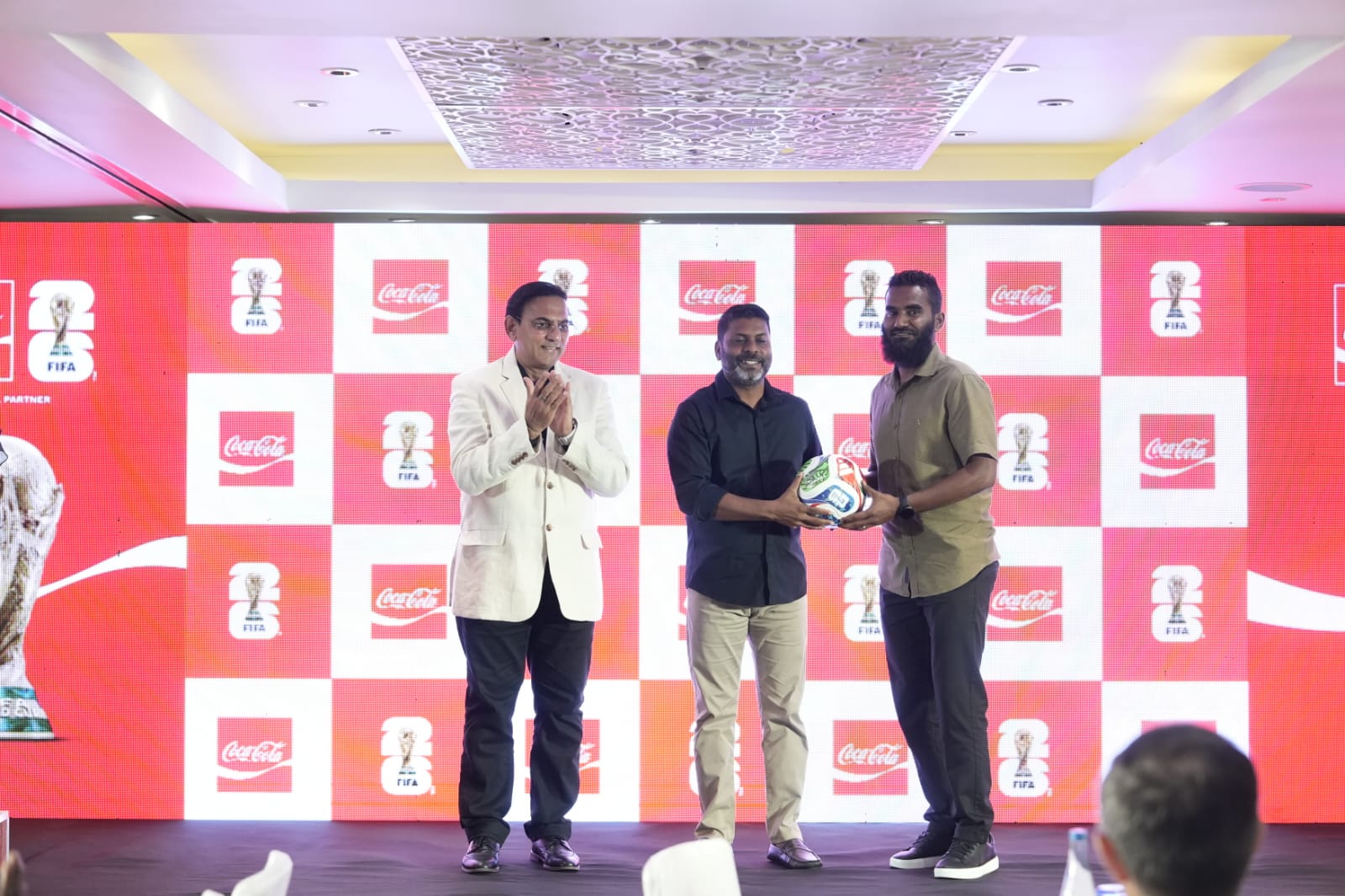
Male’ Aerated Water Company (MAWC), the authorised bottler of The Coca-Cola Company in the Maldives, on Thursday hosted the Official FIFA World Cup 2026™ Match Ball Handover Ceremony, presenting Football Legends of Maldives with official FIFA World Cup 2026™ match balls signed personally by Dr Mohamed Muizzu, President of Maldives.
Held in partnership with the Ministry of Youth Empowerment, Sports and Fitness, the ceremony recognised former national footballers whose achievements, service and influence have helped shape football in the Maldives and inspired generations of players and supporters.
The Coca-Cola Company has been an official partner of FIFA since 1974, making it one of the longest-standing partnerships in the global sport. For MAWC, the handover brought that global partnership to life locally by connecting the FIFA World Cup with people who have contributed to Maldivian football history.
As the sole authorised Coca-Cola bottler in the Maldives for over 35 years, MAWC has supported local sport through partnerships, campaigns and community initiatives. The ceremony continued that commitment by recognising the legacy of players who represented the Maldives and contributed to the growth of football in the country.
“Maldives’ football legends have given generations of supporters moments of pride and have played an important role in shaping the country’s sporting history. At MAWC, we believe recognising their contribution is as important as supporting the next generation. Through our partnership with Coca-Cola and FIFA, and in collaboration with the Ministry of Youth Empowerment, Sports and Fitness, we are honoured to celebrate their legacy. These match balls are a token of our appreciation for what they have given to Maldivian football,” said Milind Derasari, Chief Operating Officer, MAWC.
Adding to the excitement of the football season, MAWC ran a nationwide FIFA World Cup 2026™ consumer promotion from 21 March to 24 May 2026. Eight winners received an all-expenses-paid experience for two to attend a FIFA World Cup 2026™ match. Hundreds more won Coca-Cola branded merchandise and other prizes during the campaign, bringing the excitement of the world’s largest football tournament to consumers across the Maldives.
MAWC remains committed to building partnerships that support the development of sports across the Maldives, working with the Government of Maldives and other partners.
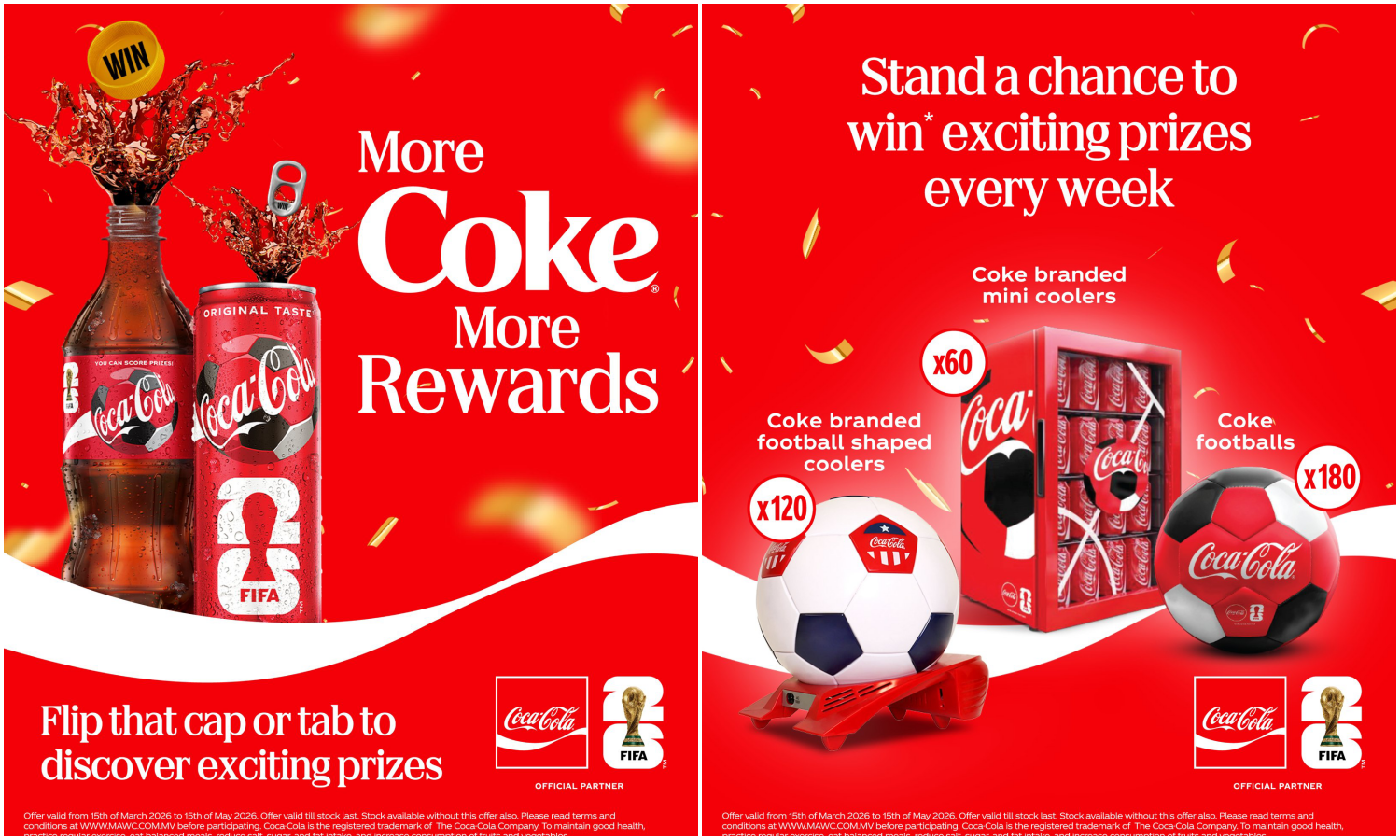
Coca-Cola Maldives is turning up the excitement with the launch of its 2026 football campaign, bringing fans across the country a season packed with prizes, shared moments and exciting ways to celebrate the game together.
As the build-up to the FIFA World Cup 2026 begins, Coca-Cola Maldives is inviting consumers to join in the fun with a campaign built around everything that makes football special: the anticipation, the matchday thrill, the watch parties, the celebrations and the memories made along the way.
From March to May, consumers in the Maldives will have the chance to take part in the Coca-Cola Maldives FIFA World Cup 2026 promotion, with weekly prizes, branded merchandise and a grand prize experience linked to one of the biggest sporting events in the world.
As part of the campaign, Coca-Cola Maldives is rolling out the UTC Promo from March 21 to May 24, giving consumers even more ways to be part of the football excitement. Special promotional packs will feature a unique code either under the cap or under the tab, depending on the product format. For 500ml, 1.25L and 2L PET bottles, codes will appear under the special Golden Caps on Coca-Cola, Sprite, Fanta Orange and Fanta Strawberry. For 330ml cans, codes will appear under the tab on Coca-Cola. Consumers can enter by sending the code via SMS to 2626 for the chance to win a range of prizes throughout the campaign period.
The promotion will run across 330ml cans as well as 500ml, 1.25L and 2L PET bottles, making it easy for consumers to join in whether they are picking up a drink for themselves, sharing with friends, or stocking up for a matchday gathering. With multiple participating brands and pack formats included in the promotion, Coca-Cola Maldives is creating more opportunities for consumers across the country to take part in the campaign and enjoy the football season together.
At the top tier, eight winners will receive an all-expenses-paid experience for two to watch a FIFA World Cup match live, creating a once-in-a-lifetime football moment. Under Tier 2, 60 winners will receive Coca-Cola branded mini-coolers, while 120 winners will take home Coca-Cola branded football-shaped personal coolers. Under Tier 3, 180 winners will receive Coke and FIFA branded footballs, adding even more play and energy to the season.
Adding a live moment to the excitement, the first set of winners will be announced on ICE TV on April 6 at 9pm, with winner announcements continuing every week throughout the promotion. This weekly reveal is set to bring an added sense of anticipation and shared excitement as the campaign unfolds across the Maldives.
The campaign is designed to bring fans closer to the game and make every football moment even more enjoyable. Whether it is watching a match with family at home, catching the action with friends at a café, or picking up a favourite Coca-Cola pack from a neighbourhood store, Coca-Cola Maldives aims to be part of the moments that make football season unforgettable.
“Football has a way of bringing people together like nothing else, and that is what inspired this campaign,” said Mario Perera, Country Head for Sri Lanka and the Maldives. “In the Maldives, the game is enjoyed in such a lively and social way, and Coca-Cola Maldives wanted to create a campaign that feels fun, relevant and easy for people to be part of. It is about celebrating the season, enjoying the experience with others, and giving fans something extra to look forward to.”
Adding to the excitement, Coca-Cola Maldives will also launch collectible country packs in the Maldives from May to July, giving fans the chance to celebrate the global game in a new way. Inspired by some of football’s most recognised nations, these limited-edition packs will bring a colourful and collectible twist to the season.
Across the Maldives, Coca-Cola Maldives will work with retail partners to bring the campaign to life through in-store visibility, promotional touchpoints and selected local activations that capture the spirit of football and community.
“The Maldives is a unique market, and Coca-Cola Maldives wanted this campaign to connect with the way people here enjoy football, together, with energy, and with a real sense of occasion. Coca-Cola Maldives is excited to bring that spirit to life in the months ahead,” added Mario Perera.
This marks the start of Coca-Cola Maldives’ 2026 journey in the market. With more fan moments, more excitement and more ways to join in still to come, Coca-Cola Maldives is looking forward to celebrating the football season with consumers across the country.
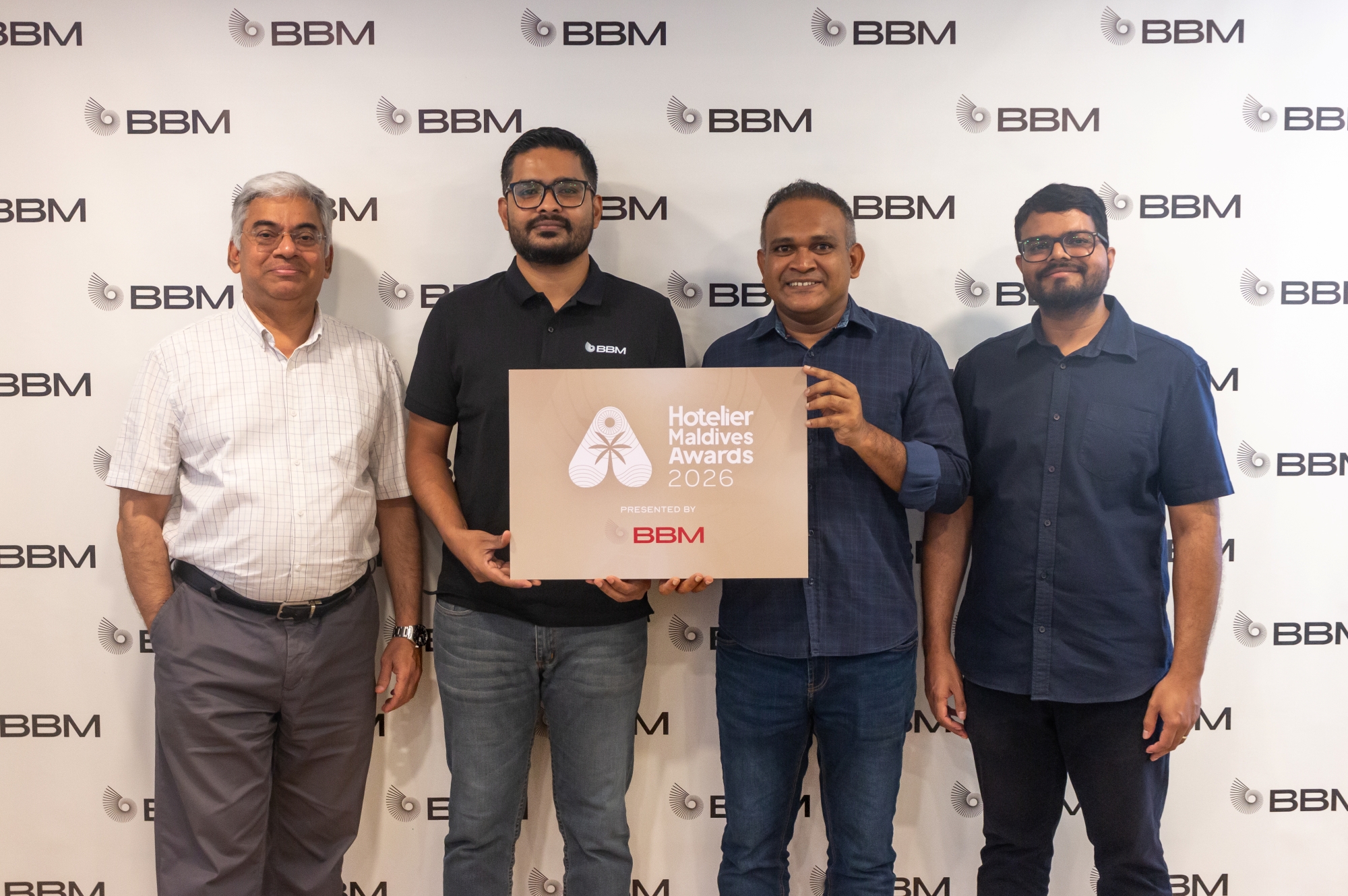
Hotelier Maldives has announced Bestbuy Maldives (BBM) as the Title Partner of Hotelier Maldives Awards 2026 under a multi-year agreement, reaffirming one of the longest-standing partnerships behind the publication’s flagship hospitality recognition platform.
The 2026 edition marks the third consecutive year that BBM has served as Title Partner of Hotelier Maldives Awards, having supported the event in the same capacity since its launch in 2024. BBM has also backed Hotelier Maldives’ second flagship event, GM Forum, every year since 2023, with 2026 set to mark its fourth year as a Silver Partner of the forum.
The continued partnership reflects a shared commitment to recognising the people behind the Maldives’ tourism industry while supporting platforms that encourage industry dialogue, leadership and professional development.
Hotelier Maldives Awards 2026 entered its public voting phase on 15 March 2026, with voting set to remain open for one month. Winners will be announced at the gala ceremony on 26 April 2026 at NIVA Kurumba Maldives.
Commenting on the partnership, Ali Naafiz, Editor of Hotelier Maldives, said: “BBM has been a valued partner of Hotelier Maldives Awards since the very beginning, and we are pleased to formalise this continued support through a multi-year agreement. Their decision to return as Title Partner for a third consecutive year reflects not only the strength of our relationship, but also a shared belief in the importance of recognising the people who drive excellence across the Maldives’ hospitality industry.
“BBM has also consistently supported GM Forum over the years, making them one of the most committed partners across our event platforms. We are proud to continue working together as we strengthen both Hotelier Maldives Awards and GM Forum as annual fixtures for the industry.”
AVS Subrahmanyam, Chief Operating Officer of BBM, said: “At BBM, we have always believed that a strong hospitality industry is built by strong people, and Hotelier Maldives Awards provides an important national platform to recognise the professionals whose work often takes place behind the scenes. We are pleased to continue as Title Partner of the awards under this multi-year agreement, while also extending our support to GM Forum for a fourth consecutive year.
“As a company that has grown alongside the Maldives’ hospitality sector, we value opportunities that celebrate talent, encourage professional pride and contribute to the long-term development of the industry. Our continued partnership with Hotelier Maldives reflects that commitment.”
Bestbuy Maldives is one of the country’s leading importers and distributors, serving the hospitality, HORECA and retail sectors with a broad portfolio of international brands. The company positions itself as a partner to the Maldivian hospitality industry, supplying products from around the world across key business verticals including resorts, foodservice and retail.
Hotelier Maldives Awards continues to recognise the contributions of resort-based hospitality professionals across the Maldives, highlighting both individual excellence and team performance. The awards programme remains the country’s only dedicated recognition platform focused on professionals working in resort operations. The current public voting round allows industry stakeholders, colleagues, guests and the wider public to take part in selecting this year’s winners.
The growing list of confirmed partners for Hotelier Maldives Awards 2026 includes Bestbuy Maldives (BBM) as Title Partner, Dhiraagu as Platinum Partner, Storm Events as Organising Partner, NIVA, Kurumba Maldives as Host Partner, Souvenir Marine as Transport Partner, ALIA as Associate Sponsor, and Lightsout Studios as Associate Partner. More partners and sponsors will be announced soon.

-

 Awards4 days ago
Three Cinnamon Maldives resorts ranked among Tripadvisor’s top 10% worldwide
-

 Cooking1 week ago
The Standard, Maldives celebrates Wellness Month with spa and culinary experiences
-

 Action1 week ago
Finolhu strengthens racquet sports programme with new tennis pro
-

 News1 week ago
Sirru Fen Fushi unveils safari-inspired luxury glamping escape
-

 Awards1 week ago
Reethi Faru Resort named among Tripadvisor’s top 10% worldwide
-

 News1 week ago
Coco Collection showcases Maldivian culture through authentic guest experiences
-

 Action1 week ago
Villa Nautica turns reef into living classroom through coral restoration project
-

 Awards7 days ago
Carne Diem Grill by Dharshan becomes Maldives’ sole entry in 50 Best Discovery 2026