

Business
On eve of bankruptcy, U.S. firms shower execs with bonuses


(Reuters) – Nearly a third of more than 40 large companies seeking U.S. bankruptcy protection during the coronavirus pandemic awarded bonuses to executives within a month of filing their cases, according to a Reuters analysis of securities filings and court records.
Under a 2005 bankruptcy law, companies are banned, with few exceptions, from paying executives retention bonuses while in bankruptcy. But the firms seized on a loophole by granting payouts before filing.
Six of the 14 companies that approved bonuses within a month of their filings cited business challenges executives faced during the pandemic in justifying the compensation.
Even more firms paid bonuses in the half-year period before their bankruptcies. Thirty-two of the 45 companies Reuters examined approved or paid bonuses within six months of filing. Nearly half authorised payouts within two months.
Eight companies, including J.C. Penney Co Inc and Hertz Global Holdings Inc, approved bonuses as few as five days before seeking bankruptcy protection. Hi-Crush Inc, a supplier of sand for oil-and-gas fracking, paid executive bonuses two days before its July 12 filing.
J.C. Penney – forced to temporarily close its 846 department stores and furlough about 78,000 of its 85,000 employees as the pandemic spread – approved nearly $10 million in payouts just before its May 15 filing. On Wednesday, the company said it would permanently close 152 stores and lay off 1,000 employees.
The company declined to comment for this story but said in an earlier statement that the bonuses aimed to retain a “talented management team” that had made progress on a turnaround before the pandemic.
The other companies declined to comment or did not respond. In filings, many said economic turmoil had rendered traditional compensation plans obsolete or that executives getting bonuses had forfeited other compensation.
Luxury retailer Neiman Marcus Group in March temporarily closed all of its 67 stores and in April furloughed more than 11,000 employees. The company paid $4 million in bonuses to Chairman and Chief Executive Geoffroy van Raemdonck in February and more than $4 million to other executives in the weeks before its May 7 bankruptcy filing, court records show. Neiman Marcus drew scrutiny this week on a plan it proposed after filing for bankruptcy to pay additional bonuses to executives. The company declined to comment.
Hertz – which recently terminated more than 14,000 workers – paid senior executives bonuses of $1.5 million days before its May 22 bankruptcy, in part to recognise the uncertainty they faced from the pandemic’s impact on travel, the company said in a filing.
Whiting Petroleum Corp bestowed $14.6 million in extra compensation to executives days before its April 1 bankruptcy. Shale pioneer Chesapeake Energy Corp awarded $25 million to executives and lower-level employees in May, about eight weeks before filing bankruptcy. Both cited fallout from the pandemic and a Saudi-Russian oil price war, which they said rendered their incentive plans ineffective.
Reuters reviewed financial disclosures and court records from 45 companies that filed for bankruptcy between March 11, the day the World Health Organization declared COVID-19 a pandemic, and July 15. Using a database provided by BankruptcyData, a division of New Generation Research Inc, Reuters reviewed companies with publicly trade stock or debt and more than $50 million in liabilities.
Such bonuses have long spurred objections that companies are enriching executives while cutting jobs, stiffing creditors and wiping out stock investors. In March, creditors sued former Toys ‘R’ Us executives and directors, accusing them of misdeeds that included paying management bonuses days before its 2017 bankruptcy. The retailer liquidated in 2018, terminating more than 31,000 people.
A lawyer for the executives and directors said the bonuses were justified, given the extra work and stress on management, and that Toys ‘R’ Us had hoped to remain in business after restructuring.
In June, congressional Democrats responded to the pandemic-induced wave of bankruptcies by introducing legislation that would strengthen creditors’ rights to claw back bonuses. The bill – the latest iteration of a proposal that has long failed to gain traction – faces slim prospects in a Republican-controlled Senate, a Democratic aide said.
Firms paying pre-bankruptcy bonuses know they would face scrutiny in court on compensation proposed after their filings, said Clifford J. White III, director of the U.S. Trustee Program, a Justice Department division charged with monitoring bankruptcy proceedings. But the trustees have no power to halt bonuses paid even days before a company’s bankruptcy filing, he said, allowing firms to “escape the transparency and court review.”
Dodging bonus restrictions
The 2005 legislation required executives and other corporate insiders to have a competing job offer in hand before receiving retention bonuses during bankruptcy, among other restrictions. That forced failing firms to devise new ways to pay the bonuses, according to some restructuring experts.
After the 2008 financial crisis, companies often proposed bonuses in bankruptcy court, casting them as incentive plans with goals executives must meet. Judges mostly approved the plans, ruling that the performance benchmarks put the compensation beyond the purview of the restrictions on retention bonuses. The plans, however, sparked objections from Justice Department monitors who called them retention bonuses in disguise, often with easy milestones.
Eventually, companies found they could avoid scrutiny altogether by approving bonuses before bankruptcy filings. Dozens of companies have approved such payouts in the last five years, said Brian Cumberland, an executive compensation expert at consulting firm Alvarez & Marsal who advises companies undergoing financial restructurings.
Companies argue the bonuses are crucial to retaining executives whose departures could torpedo their businesses, ultimately leaving less money for creditors and employees. Now, some companies are bolstering those arguments by contending that their business would not have cratered without the economic turmoil of the pandemic.
The pre-bankruptcy payouts are needed, companies say, because potential stock awards are worthless and it would be impossible for executives to meet business targets that were crafted before the economic crisis. The bonuses ensure stability in leadership that is needed to hold faltering operations together, the firms contend.
Some specialists argue the bonuses are hard to justify for executives who may have few better job options in an economic crisis.
“With double-digit unemployment, it’s a strange time to be paying out retention bonuses,” said Adam Levitin, a professor specializing in bankruptcy at Georgetown University’s law school.
Closed stores, big bonuses
J.C. Penney has not posted an annual profit since 2010 as it has struggled to grapple with the shift to online shopping and competition from discount retailers. The 118-year-old chain, at various points, employed more than 200,000 people and operated 1,600 stores, figures that have since been cut more than half.
On May 10, J.C. Penney’s board approved compensation changes that paid top executives, including CEO Jill Soltau, nearly $10 million. On May 13, Soltau received a $1.7 million long-term incentive payment and a $4.5 million retention bonus, court filings show.
The annual pay of the company’s median employee, a part-time hourly worker, was $11,482 in 2019, a company filing shows.
J.C. Penney filed for bankruptcy two days after paying Soltau’s bonuses. At a hearing the next day, a creditors’ lawyer argued the payouts were designed to thwart court review. The payouts were timed “so that they didn’t have to put it in front of you,” said the lawyer, Kristopher Hansen, addressing U.S. Bankruptcy Judge David Jones.
Jones – who is also overseeing the Whiting Petroleum, Chesapeake Energy and Neiman Marcus cases – told Reuters that such bonuses are “always a concern” in bankruptcy cases. “That said, the adversarial process demands that parties put the issue before me before I can take action,” he added, emphasising he was speaking of general dynamics applicable to any case. “A comment made in passing by a lawyer is not sufficient.”
In its statement earlier this year, J.C. Penney said the bonuses were among a series of “tough, prudent decisions” taken to safeguard the firm’s future.
Dennis Marten – a shareholder who said he once worked at a J.C. Penney store – disagrees. He has appeared at court hearings pleading for an investigation of the company’s leadership.
“Shame on her for having the gall to get that money,” he said of Soltau.
Reporting and photo: Reuters


The best way to secure the future is to create it.
Creating that future through specific, purposeful initiatives is what drives people of purpose—and, in turn, moves us all closer to the future we desire.
The Maldives is a compelling case study of a tourism-driven economy. Look around and ask why an event is being staged, what someone is working on, or where a new initiative is leading, and the answer will often point to the hospitality sector. Securing the future, therefore, is inextricably linked to strengthening and advancing that sector.

Here, “strengthening” means making the sector’s contribution more sustainable; ensuring that a greater share of its growth benefits the community; continuing to offer a compelling value proposition to the discerning global traveller; and ensuring that visitor experiences continue to generate an unparalleled reputation and valuable referrals.
To achieve these outcomes in the future, it is essential that current and future generations of the local community engage actively with the industry. Making hospitality appealing and aspirational, enhancing the quality of delivery and service, and building a pipeline of skills and talent into the sector are areas in which initiatives, inspiration, infrastructure and investment should be concentrated.

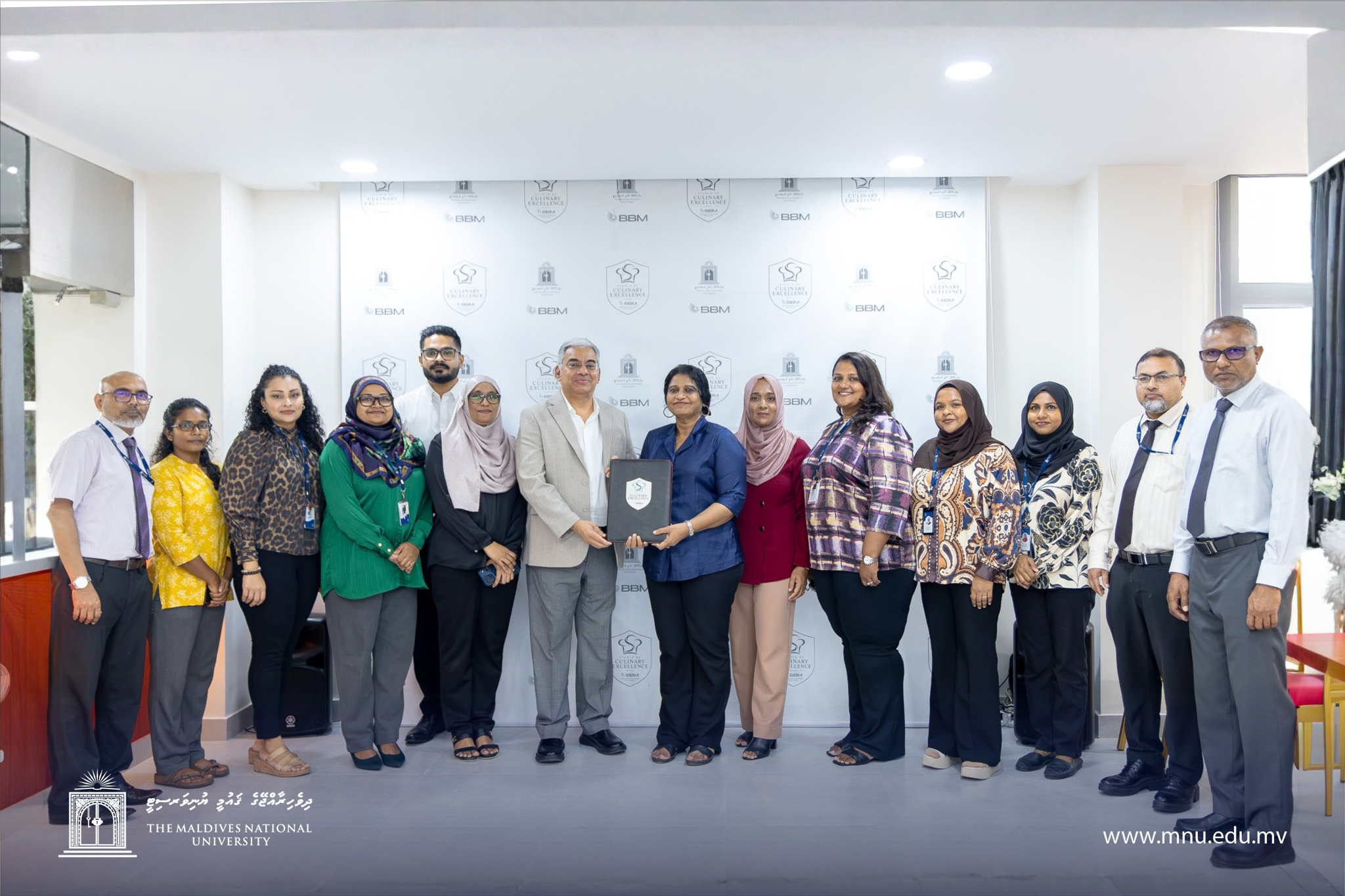
It is firmly in this context that Mr Ismail Hilmy, Chairman and Managing Director of BBM, initiated the establishment of a modern, exceptionally well-equipped and thoughtfully designed model kitchen, aptly named the Studio of Culinary Excellence. By donating the Studio to MNU, under whose auspices it will serve the Maldivian culinary community, Mr Hilmy is responding directly to the need for deeper community engagement. At the heart of BBM’s framework for industry-outreach initiatives— “Because tomorrows start today”—is Mr Hilmy’s ethos of fostering engagement and vibrancy in the industry.
“For our students, the gap between the classroom and a working resort kitchen has always been the hardest one to close,” said Dr Shehenaaz Adam, Vice Chancellor of the Maldives National University. “The Studio of Culinary Excellence closes that gap. Students can now train on the same equipment and to the same standards they will encounter on their first day in the industry. We are grateful to BBM for a partnership that goes well beyond a donation, and we look forward to the Studio becoming a place where the university and the industry learn from one another.”

The Studio therefore creates an opportunity to develop a pipeline of skills and talent in service of the industry.
“Embedding purpose in our work has been an ongoing endeavour at BBM. It keeps us connected to our stakeholders and builds insight, understanding and trust. Being a meaningful partner to academia as we move into the future gives us a great sense of fulfilment and guides our initiatives under the banner, ‘Because tomorrows start today,’” said AVS Subrahmanyam, Chief Operating Officer of BBM.
But what is the value of physical infrastructure without the corresponding spark of aspiration and ambition?

As Ali Afrah Hassan, Executive Representative at Chairman’s Office – BBM, aptly observed: “The Studio offers students and members of the community hands-on experience with world-class equipment, together with knowledge-sharing masterclasses. Who knows—in the not-too-distant future, a Michelin-starred Maldivian chef may fondly credit some of their inspiration to time spent at the Studio!”
Now that is the mind and heart in sync—working towards a future that is aspirational, ambitious and entirely attainable.
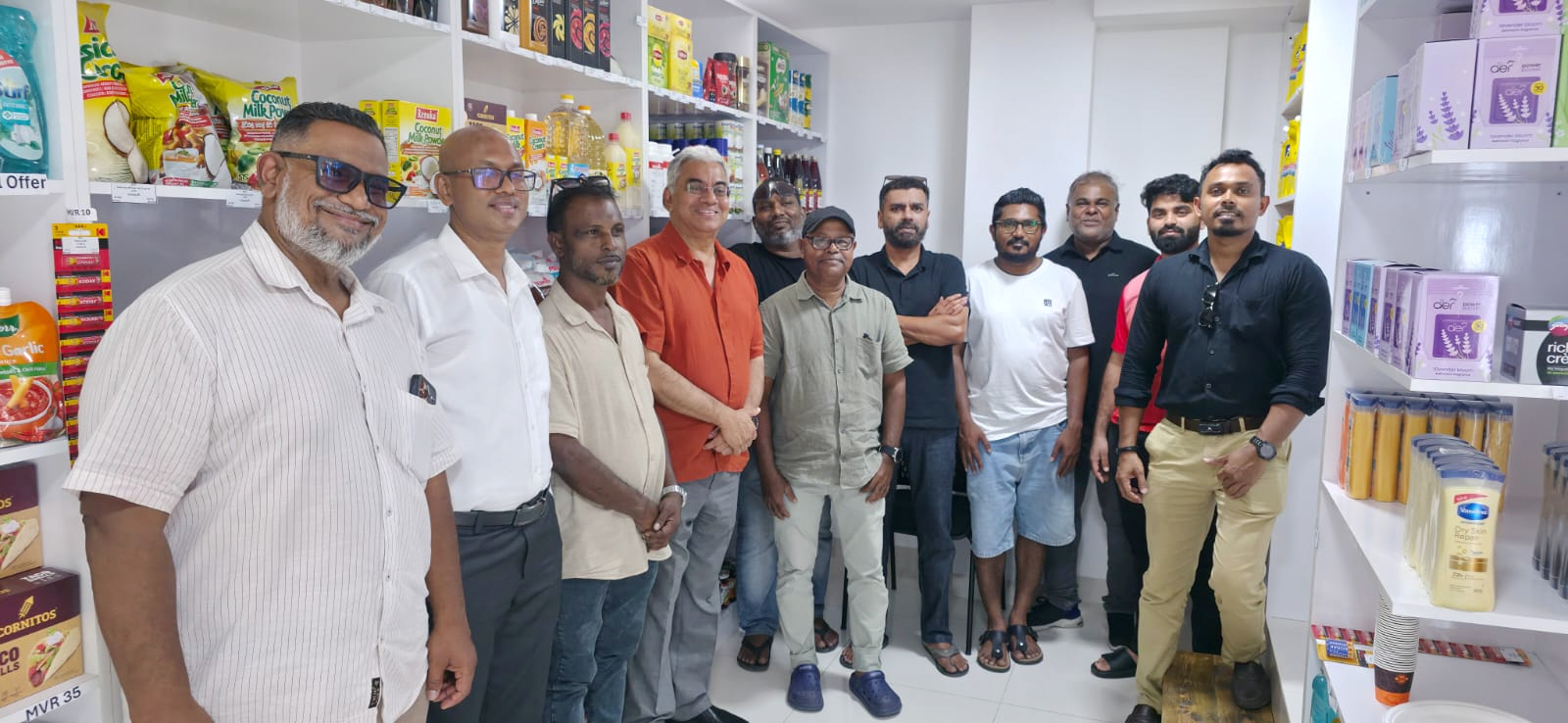
Bestbuy Maldives (BBM) has presented a brand-new Honda Airblade motorbike to the winner of a lucky draw held to mark the opening of its newest wholesale outlet in Hulhumalé Phase 2.
The outlet, located at Lot 20286 on Nirolhu Magu, opened on 16 February 2026 as part of BBM’s expansion of its wholesale operations.
To celebrate the opening and thank customers for their continued support, BBM introduced a special lucky draw exclusively for customers who made purchases from the new outlet on its opening day.

Customers who purchased products during the opening were eligible to enter the draw, with a Honda Airblade motorbike offered as the grand prize.
The lucky draw was conducted on 13 August 2026, with Ibrahim Shifaz of Vagthun Vaguthah outlet selected as the winner.
Shifaz was recently presented with the ceremonial key to the Honda Airblade by AVS Subrahmanyam, Chief Operating Officer of Bestbuy Maldives.

The promotion formed part of BBM’s activities surrounding the opening of its Hulhumalé Phase 2 outlet, which provides customers with access to the company’s range of wholesale products from the growing residential and commercial area.
Bestbuy Maldives is a supplier and distributor serving businesses across the Maldives, including customers in the hospitality, food service and retail sectors.
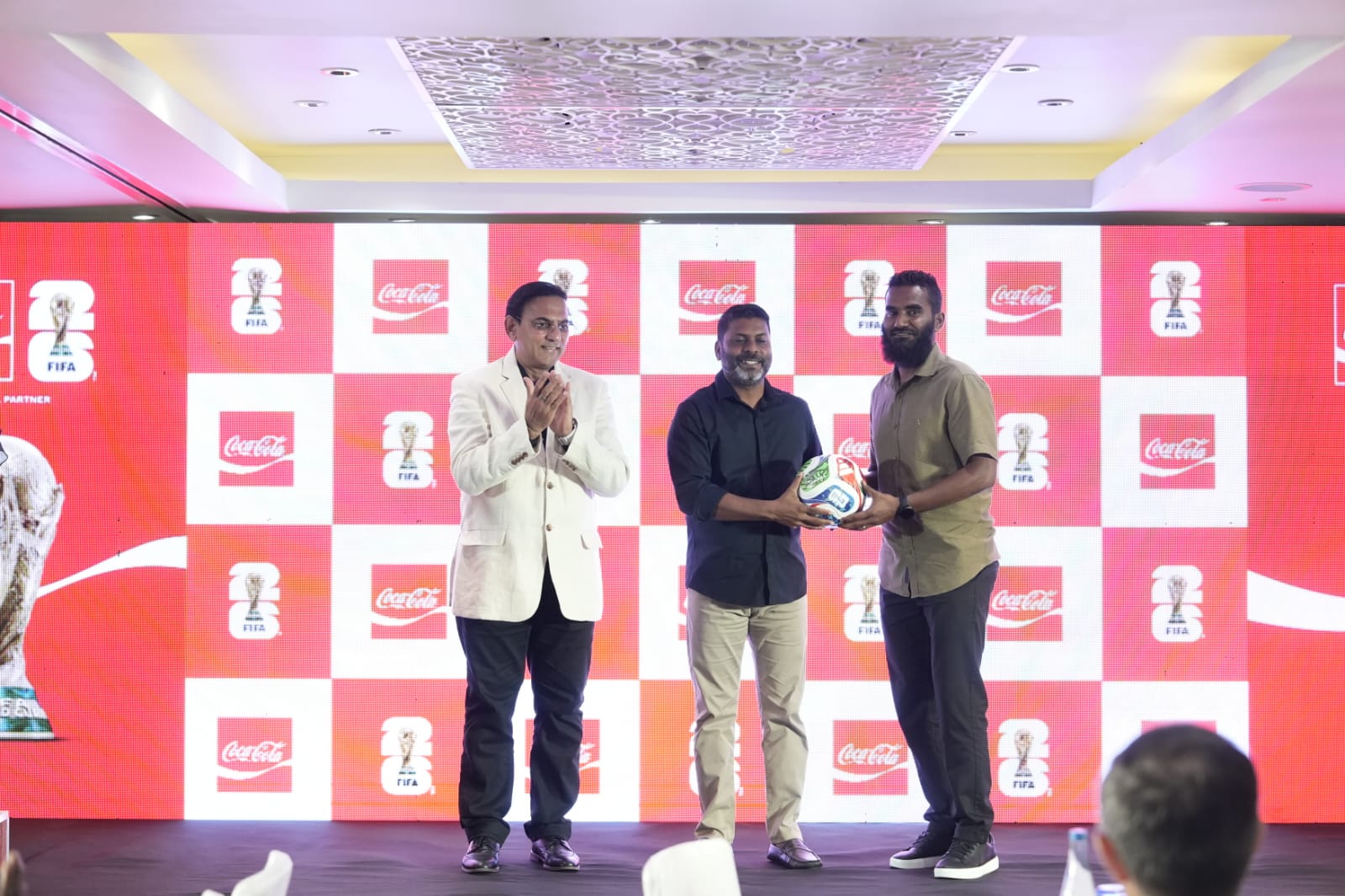
Male’ Aerated Water Company (MAWC), the authorised bottler of The Coca-Cola Company in the Maldives, on Thursday hosted the Official FIFA World Cup 2026™ Match Ball Handover Ceremony, presenting Football Legends of Maldives with official FIFA World Cup 2026™ match balls signed personally by Dr Mohamed Muizzu, President of Maldives.
Held in partnership with the Ministry of Youth Empowerment, Sports and Fitness, the ceremony recognised former national footballers whose achievements, service and influence have helped shape football in the Maldives and inspired generations of players and supporters.
The Coca-Cola Company has been an official partner of FIFA since 1974, making it one of the longest-standing partnerships in the global sport. For MAWC, the handover brought that global partnership to life locally by connecting the FIFA World Cup with people who have contributed to Maldivian football history.
As the sole authorised Coca-Cola bottler in the Maldives for over 35 years, MAWC has supported local sport through partnerships, campaigns and community initiatives. The ceremony continued that commitment by recognising the legacy of players who represented the Maldives and contributed to the growth of football in the country.
“Maldives’ football legends have given generations of supporters moments of pride and have played an important role in shaping the country’s sporting history. At MAWC, we believe recognising their contribution is as important as supporting the next generation. Through our partnership with Coca-Cola and FIFA, and in collaboration with the Ministry of Youth Empowerment, Sports and Fitness, we are honoured to celebrate their legacy. These match balls are a token of our appreciation for what they have given to Maldivian football,” said Milind Derasari, Chief Operating Officer, MAWC.
Adding to the excitement of the football season, MAWC ran a nationwide FIFA World Cup 2026™ consumer promotion from 21 March to 24 May 2026. Eight winners received an all-expenses-paid experience for two to attend a FIFA World Cup 2026™ match. Hundreds more won Coca-Cola branded merchandise and other prizes during the campaign, bringing the excitement of the world’s largest football tournament to consumers across the Maldives.
MAWC remains committed to building partnerships that support the development of sports across the Maldives, working with the Government of Maldives and other partners.

-

 Cooking1 week ago
Belgian Chef Wout Bru to bring exclusive dining experiences to Meyyafushi, Fushifaru Maldives
-

 News1 week ago
.Here Baa Atoll completes two-island concept with opening of Nowhere Private Island
-

 Cooking1 week ago
Award-winning Pastry Chef Elena Nabiullina brings contemporary pâtisserie to The Nautilus Maldives
-

 News1 week ago
Patina Maldives announces Orthodox Christmas celebrations with Russian cuisine and live entertainment
-

 News1 week ago
Six Maldives spas operated by Mandara Spa recognised in global top 100 list
-

 Action1 week ago
Adaaran Select Hudhuran Fushi brings together 40 women for surfing, wellness retreat
-

 Cooking1 week ago
Barceló Nasandhura Malé partners with Ministry of Crab for rooftop dining experience
-

 News1 week ago
COLOURS OF OBLU reveals festive experiences for families and couples across four resorts