

Business
Latin America’s stricken airlines facing long haul to recovery


Latin America’s beleaguered airlines will take up to three years to recover losses due to the coronavirus pandemic, and in the meantime desperately need government help, according to experts surveying the damage to the industry.
The International Air Transport Association (IATA) estimates it will take at least that time for the region’s airlines to inch back to their pre-pandemic level for domestic and regional flights.
Long-haul services to the United States and Europe will take until 2024 to come back, it says.
“It’s a long-range view; it will not be short term. It will take a lot of work,” said Peter Cerda, IATA vice president for the Americas.
Evidence of the severity of the crisis came last week when the region’s two largest airlines, Chilean-Brazilian LATAM and Colombia’s Avianca, filed for bankruptcy in the United States.
With countries across the region in lockdown, flight activity has plummeted 93 percent from around 200,000 a day, with losses in revenue estimated at $18 billion.

Cerda says that figure is likely to increase.
The IATA official says the impact to the industry is even worse than the aftermath of the September 11, 2001 attacks on the United States.
“We are going to have airlines that are not going to be able to recover, that will have to shut down their operations for good,” he said.
After almost three months of lockdowns and restrictions on movement across the region, airlines have run out of cash and government support is “urgent,” he says.
‘Not a rescue’

“What we are asking for is not a financial rescue. It’s support, immediate relief that allows the industry to sustain operations,” said Cerda.
Airlines are seeking tax relief and credit guarantees from governments.
Globally, government aid to the airline sector stands at $123 billion, including $300 million from Latin America, according to IATA.
“Airports and airlines as well as governments are all losing out at this juncture,” because of the lack of connectivity across the continent, says Fernando Gomez Suarez, an aviation industry analyst in Mexico.

Governments are conscious of the broader effects and Chile is considering a bailout for LATAM, seeing the airline as vital to the economy, and seeking to preserve 10,000 direct jobs as well as the livelihood of up to 200,000 people the government says are dependent on the airline indirectly.
The company has already cut 1,800 of its total 42,000 staff.
The company is also holding discussions with the governments of Brazil, Peru and Colombia to save jobs there.
Negotiations
In Brazil, the largest internal market in the region with 90 million passengers a year, private banks headed by a development bank have granted a $1.1 billion loan to its three largest airlines — Gol, Azul and LATAM.

Gol and Azul first had to agree to cut executive salaries and provide special rates and packages to stimulate recovery.
In Mexico, the region’s largest destination for foreign tourists, Tourism Minister Miguel Torruco insisted his country would continue to have “strong, solid airlines.”
IATA said talks are underway with the government to reduce airline charges.
The country’s largest, Aeromexico, will resume some routes starting Monday, though ratings agency S&P lowered its credit rating this week due to the possibility of its debt being “unsustainable.”
In Argentina, state-owned Aerolineas Argentinas announced a merger with its subsidiary Austral this month to reduce infrastructure and staff to save up to $100 million.
IATA meanwhile warned about the impact of the government’s decision to keep Argentina’s airspace closed until September.
Keep flying
Airline workers who escaped mass layoffs have had to take full or partial wage cuts to keep their jobs.

“Imagine losing half or more of your salary… and the bills keep coming in,” says Jose de Jesus Suarez, spokesman for the Mexican pilots union ASPA, whose members have gone from six flights a week to just one or two a month.
Analyst Gomez Suarez says the markets left vacant by stricken airlines will quickly be absorbed by others.
And he says their most urgent challenge will be to harmonize new health protocols between countries, which will mean higher costs for passengers.
“People will keep flying. Of course, they will have to change their habits and customs.”
Reporting and photos: AFP


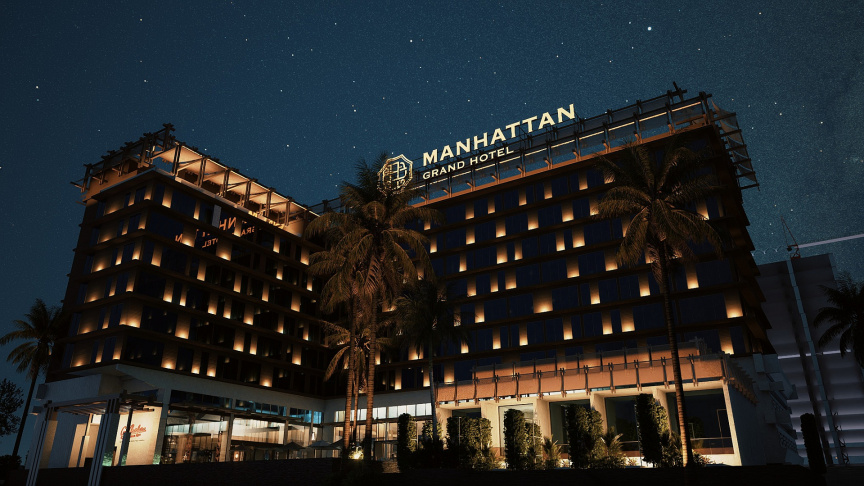
Manhattan Grand Hotel, a 162-room five-star property in Hulhumalé, was officially inaugurated on Saturday, 7 November 2026, marking the completion of a long-delayed hospitality development originally initiated by State Trading Organisation (STO) more than two decades ago.
The hotel was inaugurated by Minister of Finance and Public Enterprises Hassan Zareer during a ceremony held in Hulhumalé Phase 1. The opening marks a new chapter for the former STO City Hotel project, which remained unfinished for years despite substantial investment and repeated efforts to complete or sell the property.

Located approximately 10 minutes from Velana International Airport, Manhattan Grand Hotel has been developed to accommodate business travellers, transit passengers, leisure visitors and long-stay guests, while providing facilities for meetings, conferences, exhibitions and social events.
The property features 162 rooms and suites across eight accommodation categories, including city-view and sea-view rooms, deluxe accommodation and junior suites. Its facilities include four food and beverage outlets, an outdoor swimming pool, a spa and wellness centre, and a fitness centre.
A central feature of the hotel is its meetings, incentives, conferences and exhibitions (MICE) infrastructure. The property offers three major event halls, measuring approximately 700, 400 and 390 square metres, alongside dedicated meeting rooms and conference facilities. The venues have been developed to accommodate corporate conferences, exhibitions, annual general meetings, weddings, banquets and other large-scale gatherings.
The hotel’s architectural concept draws inspiration from Hukuru Miskiy, the historic Friday Mosque in Malé, incorporating elements of traditional Maldivian craftsmanship into its contemporary design. Marketed under the concept ‘Live the Heritage’, the property aims to combine local cultural influences with modern urban hospitality.
Manhattan Grand Hotel is operated by World of Business Pvt Ltd, with foreign investment from UAE-based Deep Seafood Company. The redevelopment was formalised through an agreement with Housing Development Corporation (HDC) in August 2025, under an arrangement involving 50 per cent foreign investment.
The property’s development history dates back to 2006, when STO approved plans to establish a city hotel in Hulhumalé as part of efforts to generate foreign currency revenue. Construction of the originally proposed 250-room five-star hotel began in 2011, following plans involving the US-based Carlson Hotel Group.
However, the development encountered repeated delays, leaving the building unfinished for more than a decade. STO subsequently explored several options to dispose of or complete the property before arrangements were made with HDC to facilitate its redevelopment.
The revised development also incorporates approximately three and a half floors designated for government-related facilities, including a media village, youth centre, heritage college and medical college.
Ahead of its formal inauguration, Manhattan Grand Hotel had already begun hosting hospitality industry events. The property hosted Food & Hospitality Asia Maldives (FHAM) 2026 from 7 to 9 September, bringing together hospitality suppliers, industry professionals and international exhibitors.
The hotel’s official opening adds a substantial accommodation and events facility to the Greater Malé region, supporting the growing demand for city-based hospitality services, corporate gatherings and accommodation close to the country’s main international airport.
The completion of the former STO City Hotel project also brings an end to one of Hulhumalé’s longest-running unfinished hospitality developments, converting the property into a functioning hotel and events destination.
The best way to secure the future is to create it.
Creating that future through specific, purposeful initiatives is what drives people of purpose—and, in turn, moves us all closer to the future we desire.
The Maldives is a compelling case study of a tourism-driven economy. Look around and ask why an event is being staged, what someone is working on, or where a new initiative is leading, and the answer will often point to the hospitality sector. Securing the future, therefore, is inextricably linked to strengthening and advancing that sector.

Here, “strengthening” means making the sector’s contribution more sustainable; ensuring that a greater share of its growth benefits the community; continuing to offer a compelling value proposition to the discerning global traveller; and ensuring that visitor experiences continue to generate an unparalleled reputation and valuable referrals.
To achieve these outcomes in the future, it is essential that current and future generations of the local community engage actively with the industry. Making hospitality appealing and aspirational, enhancing the quality of delivery and service, and building a pipeline of skills and talent into the sector are areas in which initiatives, inspiration, infrastructure and investment should be concentrated.

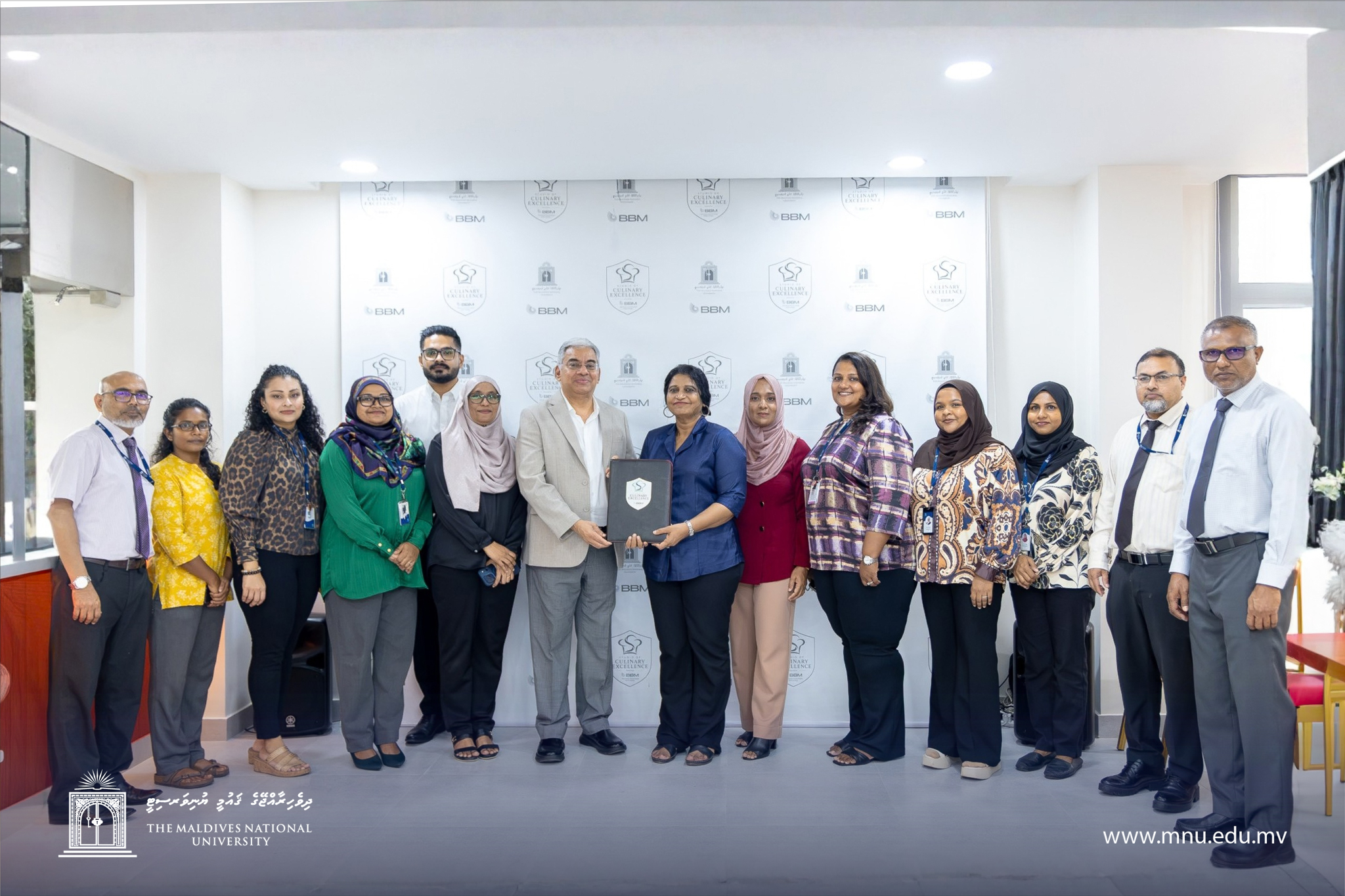
It is firmly in this context that Mr Ismail Hilmy, Chairman and Managing Director of BBM, initiated the establishment of a modern, exceptionally well-equipped and thoughtfully designed model kitchen, aptly named the Studio of Culinary Excellence. By donating the Studio to MNU, under whose auspices it will serve the Maldivian culinary community, Mr Hilmy is responding directly to the need for deeper community engagement. At the heart of BBM’s framework for industry-outreach initiatives— “Because tomorrows start today”—is Mr Hilmy’s ethos of fostering engagement and vibrancy in the industry.
“For our students, the gap between the classroom and a working resort kitchen has always been the hardest one to close,” said Dr Shehenaaz Adam, Vice Chancellor of the Maldives National University. “The Studio of Culinary Excellence closes that gap. Students can now train on the same equipment and to the same standards they will encounter on their first day in the industry. We are grateful to BBM for a partnership that goes well beyond a donation, and we look forward to the Studio becoming a place where the university and the industry learn from one another.”

The Studio therefore creates an opportunity to develop a pipeline of skills and talent in service of the industry.
“Embedding purpose in our work has been an ongoing endeavour at BBM. It keeps us connected to our stakeholders and builds insight, understanding and trust. Being a meaningful partner to academia as we move into the future gives us a great sense of fulfilment and guides our initiatives under the banner, ‘Because tomorrows start today,’” said AVS Subrahmanyam, Chief Operating Officer of BBM.
But what is the value of physical infrastructure without the corresponding spark of aspiration and ambition?

As Ali Afrah Hassan, Executive Representative at Chairman’s Office – BBM, aptly observed: “The Studio offers students and members of the community hands-on experience with world-class equipment, together with knowledge-sharing masterclasses. Who knows—in the not-too-distant future, a Michelin-starred Maldivian chef may fondly credit some of their inspiration to time spent at the Studio!”
Now that is the mind and heart in sync—working towards a future that is aspirational, ambitious and entirely attainable.
Bestbuy Maldives (BBM) has presented a brand-new Honda Airblade motorbike to the winner of a lucky draw held to mark the opening of its newest wholesale outlet in Hulhumalé Phase 2.
The outlet, located at Lot 20286 on Nirolhu Magu, opened on 16 February 2026 as part of BBM’s expansion of its wholesale operations.
To celebrate the opening and thank customers for their continued support, BBM introduced a special lucky draw exclusively for customers who made purchases from the new outlet on its opening day.

Customers who purchased products during the opening were eligible to enter the draw, with a Honda Airblade motorbike offered as the grand prize.
The lucky draw was conducted on 13 August 2026, with Ibrahim Shifaz of Vagthun Vaguthah outlet selected as the winner.
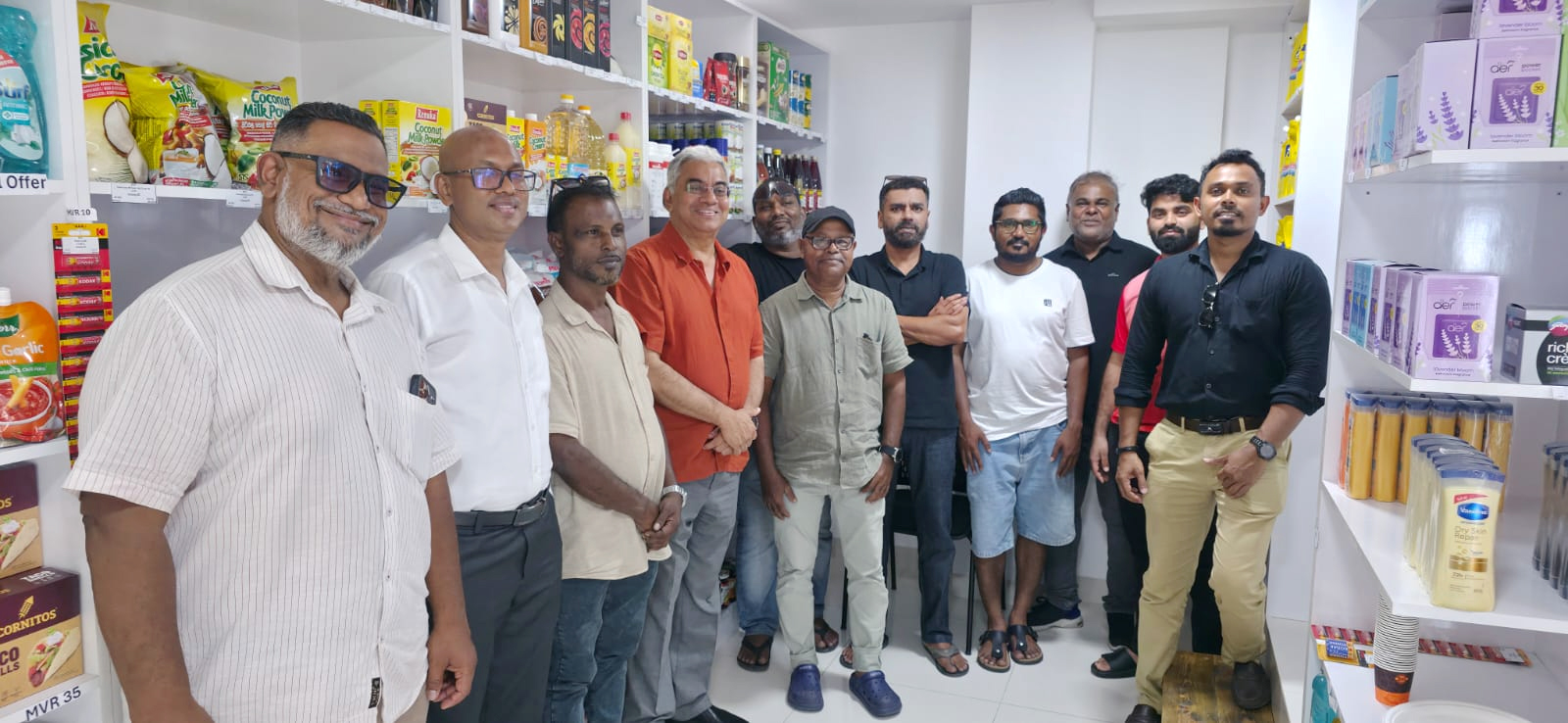
Shifaz was recently presented with the ceremonial key to the Honda Airblade by AVS Subrahmanyam, Chief Operating Officer of Bestbuy Maldives.

The promotion formed part of BBM’s activities surrounding the opening of its Hulhumalé Phase 2 outlet, which provides customers with access to the company’s range of wholesale products from the growing residential and commercial area.
Bestbuy Maldives is a supplier and distributor serving businesses across the Maldives, including customers in the hospitality, food service and retail sectors.

-

 Awards1 week ago
Veligandu Maldives receives One MICHELIN Key recognition for luxury hospitality
-

 Love1 week ago
The Nautilus Maldives to celebrate Valentine’s 2027 with ‘Love Freely’ experiences
-

 News1 week ago
The Westin Maldives Miriandhoo Resort introduces ‘Garden of Eve’ Christmas and New Year celebrations
-

 News1 week ago
Banyan Tree Vabbinfaru welcomes Consuelo Saroyan for exclusive wellness residency
-

 News1 week ago
Nova Maldives embraces ‘Headspace Holidays’ trend with wellness experiences
-

 News1 week ago
Sun Siyam Vilu Reef opens new beach club and Italian restaurant
-

 News1 week ago
Cinnamon Maldives offers three additional benefits in 11.11 booking promotion
-

 News1 week ago
Bandos Maldives strengthens food safety and sustainability standards with dual recognition