

Business
Luxury food industry turns sour amid global coronavirus lockdowns


SINGAPORE/TOKYO/PARIS (Reuters) – Global demand for premium foods like wagyu beef, bluefin tuna and caviar has plunged with thousands of restaurants shuttered and many economies sliding into recession amid the coronavirus pandemic.
As strict lockdown measures to contain the outbreak ravage global economic activity, the luxury food industry could be among the worst hit since it heavily relies on restaurants and top hotels for demand for deluxe items from caviar to champagne.
While some gourmet food producers are tapping consumers directly to stay afloat, others have been forced to cut output as some products have lost nearly half their value since the start of the year.
Jean-Marie Barillere, co-chairman of champagne producers’ lobby CIVC in France, said he hoped people would celebrate the easing of lockdown with a bottle of champagne, but expected a difficult end to the year.
“This is really a period that looks like a war time,” he said.
Bookings data compiled by OpenTable, an online restaurant reservation service, showed a near 80% year-on-year decline in seated diners at restaurants in the United States, United Kingdom, Germany, Canada, Australia, Ireland and Mexico this year.
People are also less likely to consume luxury foods when stuck at home in the middle of a health crisis and worried about their financial situation, or under clinical social distancing measures as eateries reopen.
“People will not want to taste a Chateau Petrus wine, a lobster or caviar under a bell jar,” said Michel Berthommier, managing director of Caviar Perlita in southwestern France.
“If you force people to eat in these conditions they will prefer going to fast foods.”
Deep discounts
Premium foods was “one of the worst hit sectors worldwide”, said Ole Houe, director of advisory services at agriculture brokerage IKON Commodities in Sydney. He said he did not expect a prompt recovery given many countries were in recession.
Falling demand has already taken a toll on the prices of luxury items.
In Tokyo, the price of top quality wagyu beef cuts has fallen about 30% from a year earlier, bluefin tuna – considered the best in Japan – has dropped more than 40% over that period, while prices of the famed ‘Earl’s melons’ from Shizuoka have slumped 30%.
Russia’s top sturgeon breeding company – Russian Caviar House – meanwhile was offering a 30% discount for Beluga hybrid caviar.
“Spring and summer are always low seasons for the caviar market, but if we compare this period with previous years, the sales in Russia are down 50%,” said the firm’s owner Alexander Novikov.
In France, caviar prices languished near historic lows, champagne sales tumbled, while foie gras producers have had to cut output to prop up prices.
Cifog, a foie gras producers’ group, said restaurants account for 40% of total foie gras sales.
“Mid-March it felt like the sky had fallen on us,” said Florian Boucherie, who produces 2 tonnes of foie gras per year in France.
Oyster and razor clam fishermen from Cape Cod and other top fishing grounds have also had to curb catches as lockdowns upended global eating habits.
Going down
To plug the yawning gap left by eateries, many high-end food producers are attempting to reach consumers directly via e-commerce platforms.
Others are steering more produce onto supermarket shelves.
“We are accelerating our supply of products into some of the world’s largest supermarkets, gourmet butchers and direct to consumers online,” said Hugh Killen, chief executive of Australia’s largest listed beef producer, Australian Agricultural Company (AAC.AX).
But some vendors say selling to supermarkets is far less profitable than selling to high-end restaurants.
In Japan, top sushi chefs pay 400,000 yen ($3,737.97) for 10kg of the best cuts of tuna compared to the 25,000 yen paid by supermarkets for 10kg of lower value cuts, said Yukitaka Yamaguchi, owner of Yamayuki tuna brokerage at Toyosu Market in Tokyo.
He said “the best part of (the) tuna” was usually sold first to high-end sushi restaurants but when these closed the “harakami had nowhere to go.” They eventually started offering high-quality tuna to fish retailers and supermarkets.
For now, Yamaguchi has had to park plans to retire as he has accumulated debt during the pandemic.
“I had planned to retire when I turn 60, but that’s no longer possible,” he said.
Reporting and photo: Reuters


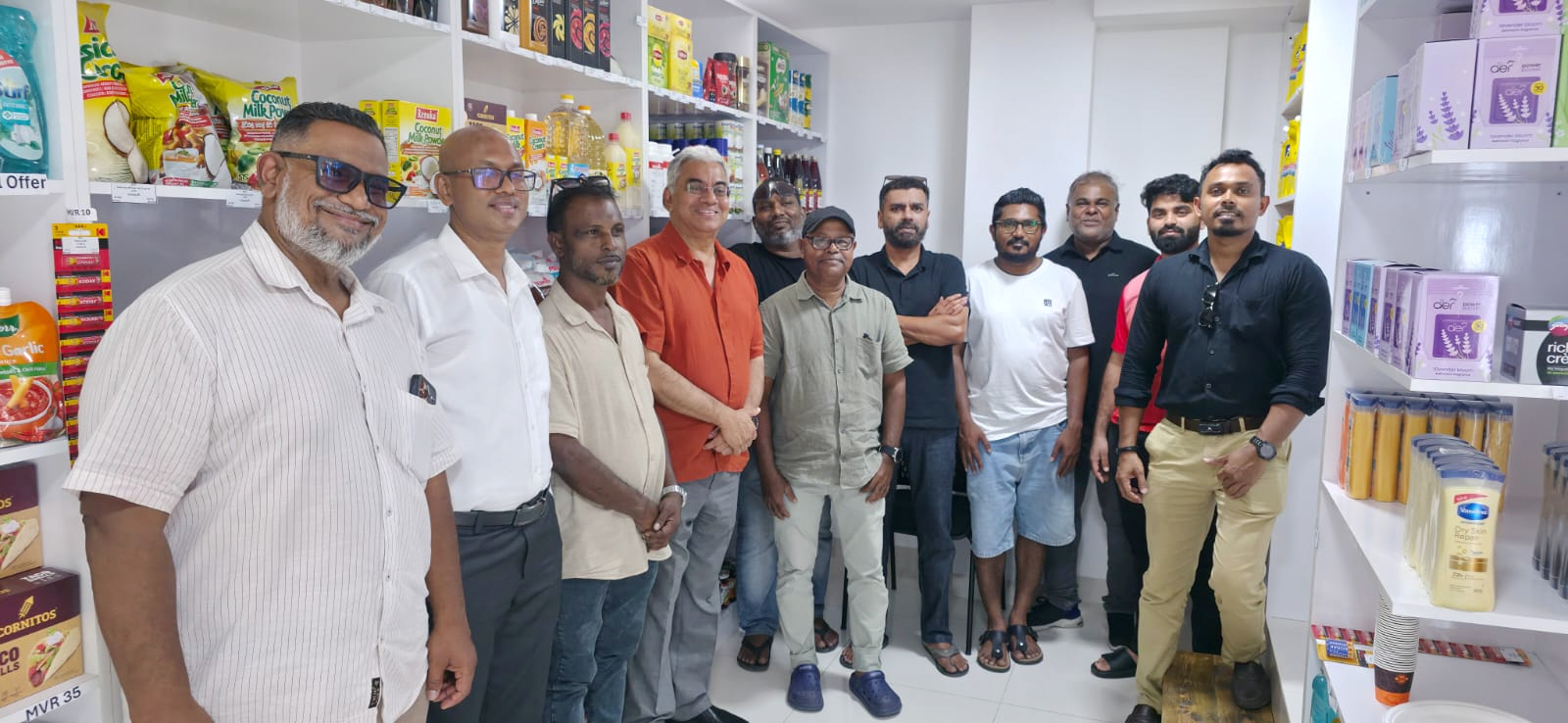
Bestbuy Maldives (BBM) has presented a brand-new Honda Airblade motorbike to the winner of a lucky draw held to mark the opening of its newest wholesale outlet in Hulhumalé Phase 2.
The outlet, located at Lot 20286 on Nirolhu Magu, opened on 16 February 2026 as part of BBM’s expansion of its wholesale operations.
To celebrate the opening and thank customers for their continued support, BBM introduced a special lucky draw exclusively for customers who made purchases from the new outlet on its opening day.

Customers who purchased products during the opening were eligible to enter the draw, with a Honda Airblade motorbike offered as the grand prize.
The lucky draw was conducted on 13 August 2026, with Ibrahim Shifaz of Vagthun Vaguthah outlet selected as the winner.
Shifaz was recently presented with the ceremonial key to the Honda Airblade by AVS Subrahmanyam, Chief Operating Officer of Bestbuy Maldives.

The promotion formed part of BBM’s activities surrounding the opening of its Hulhumalé Phase 2 outlet, which provides customers with access to the company’s range of wholesale products from the growing residential and commercial area.
Bestbuy Maldives is a supplier and distributor serving businesses across the Maldives, including customers in the hospitality, food service and retail sectors.
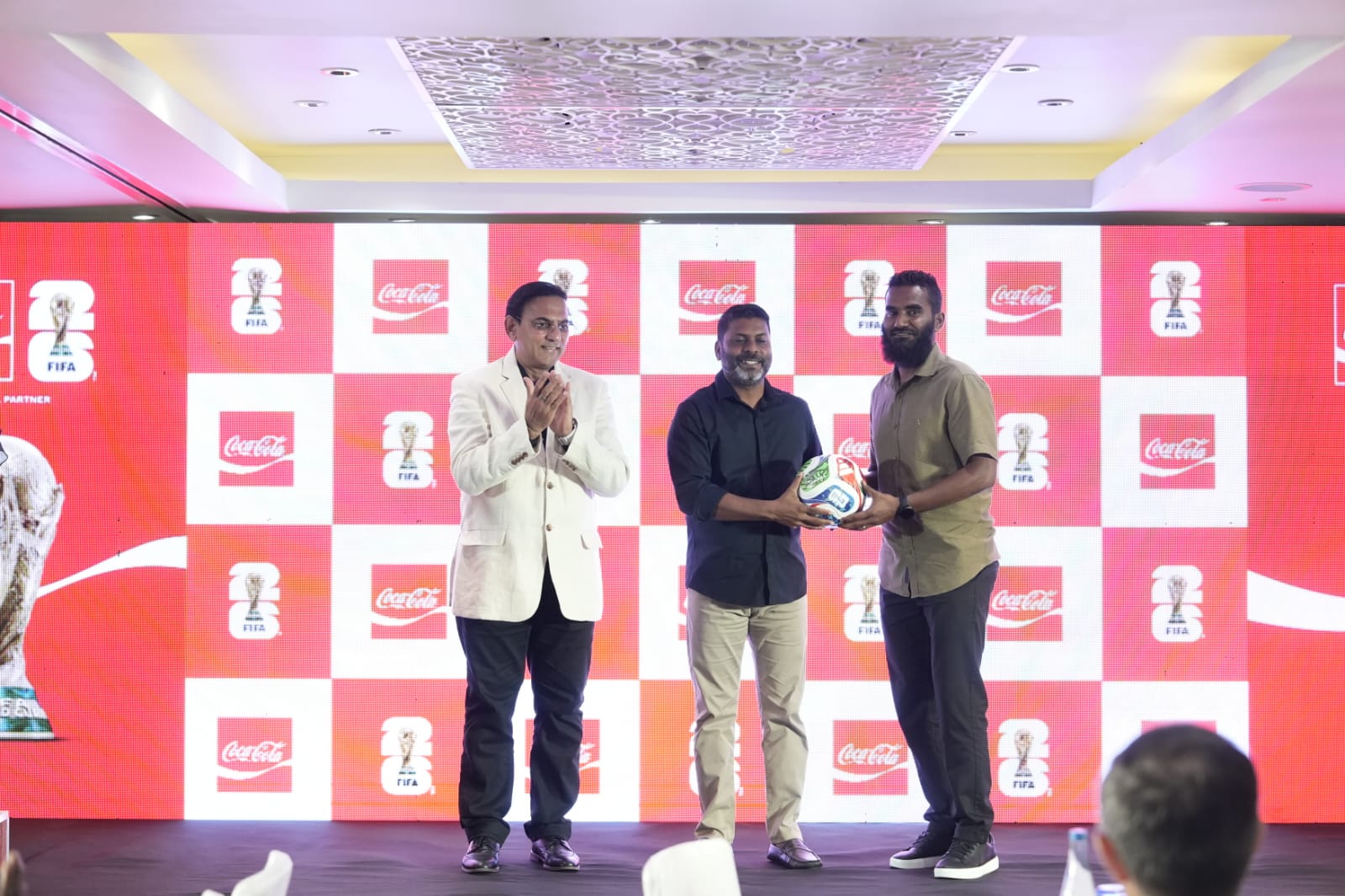
Male’ Aerated Water Company (MAWC), the authorised bottler of The Coca-Cola Company in the Maldives, on Thursday hosted the Official FIFA World Cup 2026™ Match Ball Handover Ceremony, presenting Football Legends of Maldives with official FIFA World Cup 2026™ match balls signed personally by Dr Mohamed Muizzu, President of Maldives.
Held in partnership with the Ministry of Youth Empowerment, Sports and Fitness, the ceremony recognised former national footballers whose achievements, service and influence have helped shape football in the Maldives and inspired generations of players and supporters.
The Coca-Cola Company has been an official partner of FIFA since 1974, making it one of the longest-standing partnerships in the global sport. For MAWC, the handover brought that global partnership to life locally by connecting the FIFA World Cup with people who have contributed to Maldivian football history.
As the sole authorised Coca-Cola bottler in the Maldives for over 35 years, MAWC has supported local sport through partnerships, campaigns and community initiatives. The ceremony continued that commitment by recognising the legacy of players who represented the Maldives and contributed to the growth of football in the country.
“Maldives’ football legends have given generations of supporters moments of pride and have played an important role in shaping the country’s sporting history. At MAWC, we believe recognising their contribution is as important as supporting the next generation. Through our partnership with Coca-Cola and FIFA, and in collaboration with the Ministry of Youth Empowerment, Sports and Fitness, we are honoured to celebrate their legacy. These match balls are a token of our appreciation for what they have given to Maldivian football,” said Milind Derasari, Chief Operating Officer, MAWC.
Adding to the excitement of the football season, MAWC ran a nationwide FIFA World Cup 2026™ consumer promotion from 21 March to 24 May 2026. Eight winners received an all-expenses-paid experience for two to attend a FIFA World Cup 2026™ match. Hundreds more won Coca-Cola branded merchandise and other prizes during the campaign, bringing the excitement of the world’s largest football tournament to consumers across the Maldives.
MAWC remains committed to building partnerships that support the development of sports across the Maldives, working with the Government of Maldives and other partners.
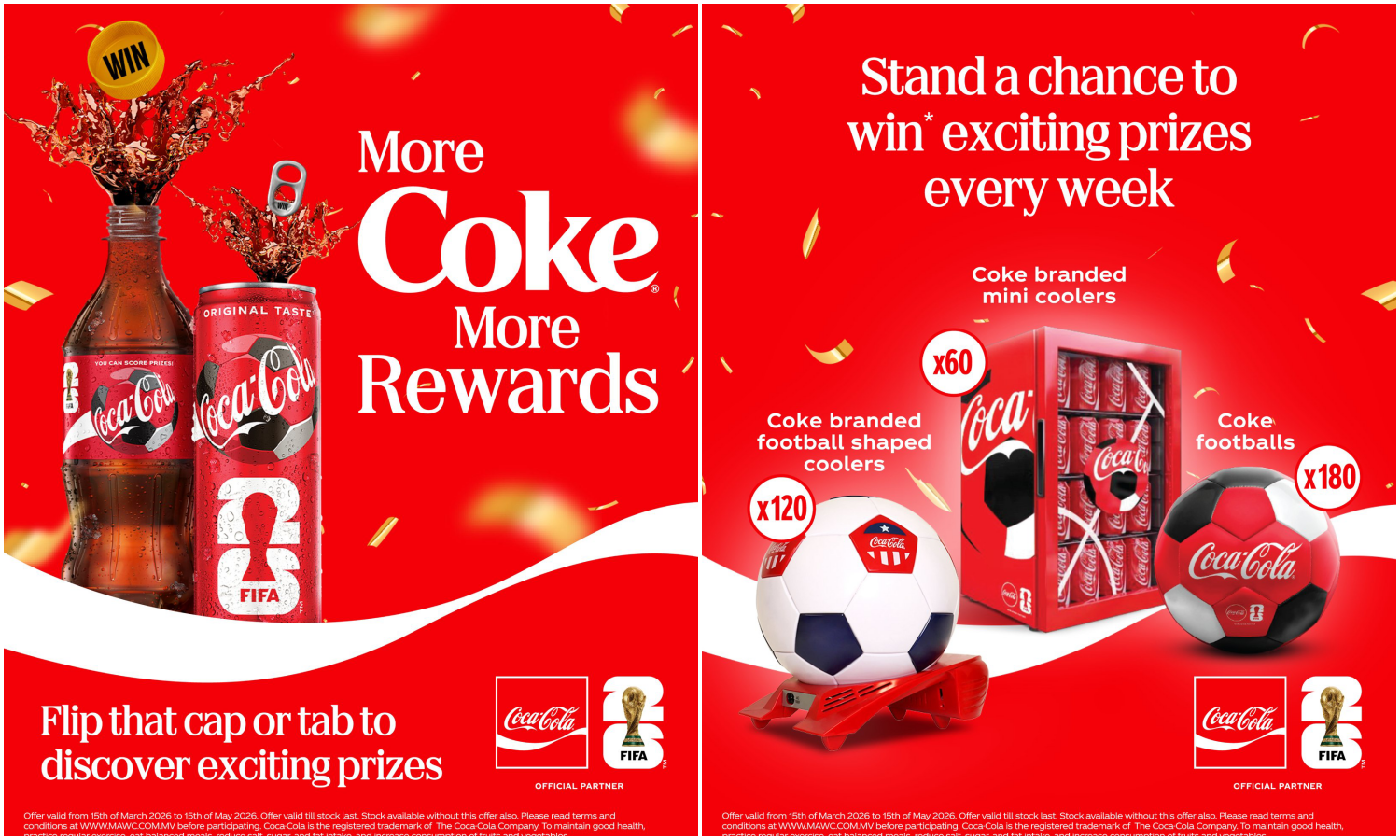
Coca-Cola Maldives is turning up the excitement with the launch of its 2026 football campaign, bringing fans across the country a season packed with prizes, shared moments and exciting ways to celebrate the game together.
As the build-up to the FIFA World Cup 2026 begins, Coca-Cola Maldives is inviting consumers to join in the fun with a campaign built around everything that makes football special: the anticipation, the matchday thrill, the watch parties, the celebrations and the memories made along the way.
From March to May, consumers in the Maldives will have the chance to take part in the Coca-Cola Maldives FIFA World Cup 2026 promotion, with weekly prizes, branded merchandise and a grand prize experience linked to one of the biggest sporting events in the world.
As part of the campaign, Coca-Cola Maldives is rolling out the UTC Promo from March 21 to May 24, giving consumers even more ways to be part of the football excitement. Special promotional packs will feature a unique code either under the cap or under the tab, depending on the product format. For 500ml, 1.25L and 2L PET bottles, codes will appear under the special Golden Caps on Coca-Cola, Sprite, Fanta Orange and Fanta Strawberry. For 330ml cans, codes will appear under the tab on Coca-Cola. Consumers can enter by sending the code via SMS to 2626 for the chance to win a range of prizes throughout the campaign period.
The promotion will run across 330ml cans as well as 500ml, 1.25L and 2L PET bottles, making it easy for consumers to join in whether they are picking up a drink for themselves, sharing with friends, or stocking up for a matchday gathering. With multiple participating brands and pack formats included in the promotion, Coca-Cola Maldives is creating more opportunities for consumers across the country to take part in the campaign and enjoy the football season together.
At the top tier, eight winners will receive an all-expenses-paid experience for two to watch a FIFA World Cup match live, creating a once-in-a-lifetime football moment. Under Tier 2, 60 winners will receive Coca-Cola branded mini-coolers, while 120 winners will take home Coca-Cola branded football-shaped personal coolers. Under Tier 3, 180 winners will receive Coke and FIFA branded footballs, adding even more play and energy to the season.
Adding a live moment to the excitement, the first set of winners will be announced on ICE TV on April 6 at 9pm, with winner announcements continuing every week throughout the promotion. This weekly reveal is set to bring an added sense of anticipation and shared excitement as the campaign unfolds across the Maldives.
The campaign is designed to bring fans closer to the game and make every football moment even more enjoyable. Whether it is watching a match with family at home, catching the action with friends at a café, or picking up a favourite Coca-Cola pack from a neighbourhood store, Coca-Cola Maldives aims to be part of the moments that make football season unforgettable.
“Football has a way of bringing people together like nothing else, and that is what inspired this campaign,” said Mario Perera, Country Head for Sri Lanka and the Maldives. “In the Maldives, the game is enjoyed in such a lively and social way, and Coca-Cola Maldives wanted to create a campaign that feels fun, relevant and easy for people to be part of. It is about celebrating the season, enjoying the experience with others, and giving fans something extra to look forward to.”
Adding to the excitement, Coca-Cola Maldives will also launch collectible country packs in the Maldives from May to July, giving fans the chance to celebrate the global game in a new way. Inspired by some of football’s most recognised nations, these limited-edition packs will bring a colourful and collectible twist to the season.
Across the Maldives, Coca-Cola Maldives will work with retail partners to bring the campaign to life through in-store visibility, promotional touchpoints and selected local activations that capture the spirit of football and community.
“The Maldives is a unique market, and Coca-Cola Maldives wanted this campaign to connect with the way people here enjoy football, together, with energy, and with a real sense of occasion. Coca-Cola Maldives is excited to bring that spirit to life in the months ahead,” added Mario Perera.
This marks the start of Coca-Cola Maldives’ 2026 journey in the market. With more fan moments, more excitement and more ways to join in still to come, Coca-Cola Maldives is looking forward to celebrating the football season with consumers across the country.

-

 Cooking1 week ago
Vakkaru Maldives welcomes back Chef Jesper Koch for autumn culinary residency
-

 Entertainment7 days ago
Ifuru Island Maldives to stage four nights of music and culture with Ripple & Friends
-

 News1 week ago
Chavana Spa introduces personalised wellness journeys in Maldives
-

 News1 week ago
Mandara Spa launches immersive wellness journeys across Maldives resorts
-
 News1 week ago
Football stars, freestyle champions headline Kandima Maldives’ Summer Kamp 2026
-

 Action5 days ago
Royal Island takes Best Dive Resort honour at TTM Awards 2026
-

 Cooking7 days ago
Riva enters new chapter with Mediterranean concept at JW Marriott Maldives Kaafu Atoll
-

 News6 days ago
Sirru Fen Fushi celebrates Golden Week and Mid-Autumn Festival with Golden Autumn Escape